
The Insurance Producers Guild
The Insurance Producers Guild is a strategic briefing for insurance professionals, focused on Medicare, ACA, life insurance, and the evolving insurance landscape. Each episode distills complex industry changes into clear, practical intelligence.
The Insurance Producers Guild
EP14 Medicare Service in 2026 - Agencies That Deliver Will Grow
Use Left/Right to seek, Home/End to jump to start or end. Hold shift to jump forward or backward.
📝 Episode Description
In Episode 14, we explore one of the most overlooked drivers of Medicare agency growth: service.
With Medicare Advantage enrollment continuing to grow and CMS pushing for more efficient processes, agencies that are responsive, organized, and easy to work with have a clear advantage in retention and referrals.
This episode covers practical strategies for improving intake, setting callback expectations, documenting client interactions, and communicating confidently with beneficiaries who need guidance.
We also discuss how strong service can uncover additional client needs and create opportunities for ethical growth. Learn how a consistent service process can strengthen client relationships and help your agency grow.
🔑 Key Topics Covered
• Medicare Advantage growth and the expansion of Special Needs Plans
• CMS efforts to improve prior authorization and information sharing
• Building a service process that improves retention and referrals
• Using client service conversations to identify additional needs ethically
🎯 What This Means for Agents
• Strong service can become a key driver of growth and retention
• Clear communication builds trust and generates more referrals
• Consistent processes create a better client experience
• Service-focused agencies are better positioned for long-term success
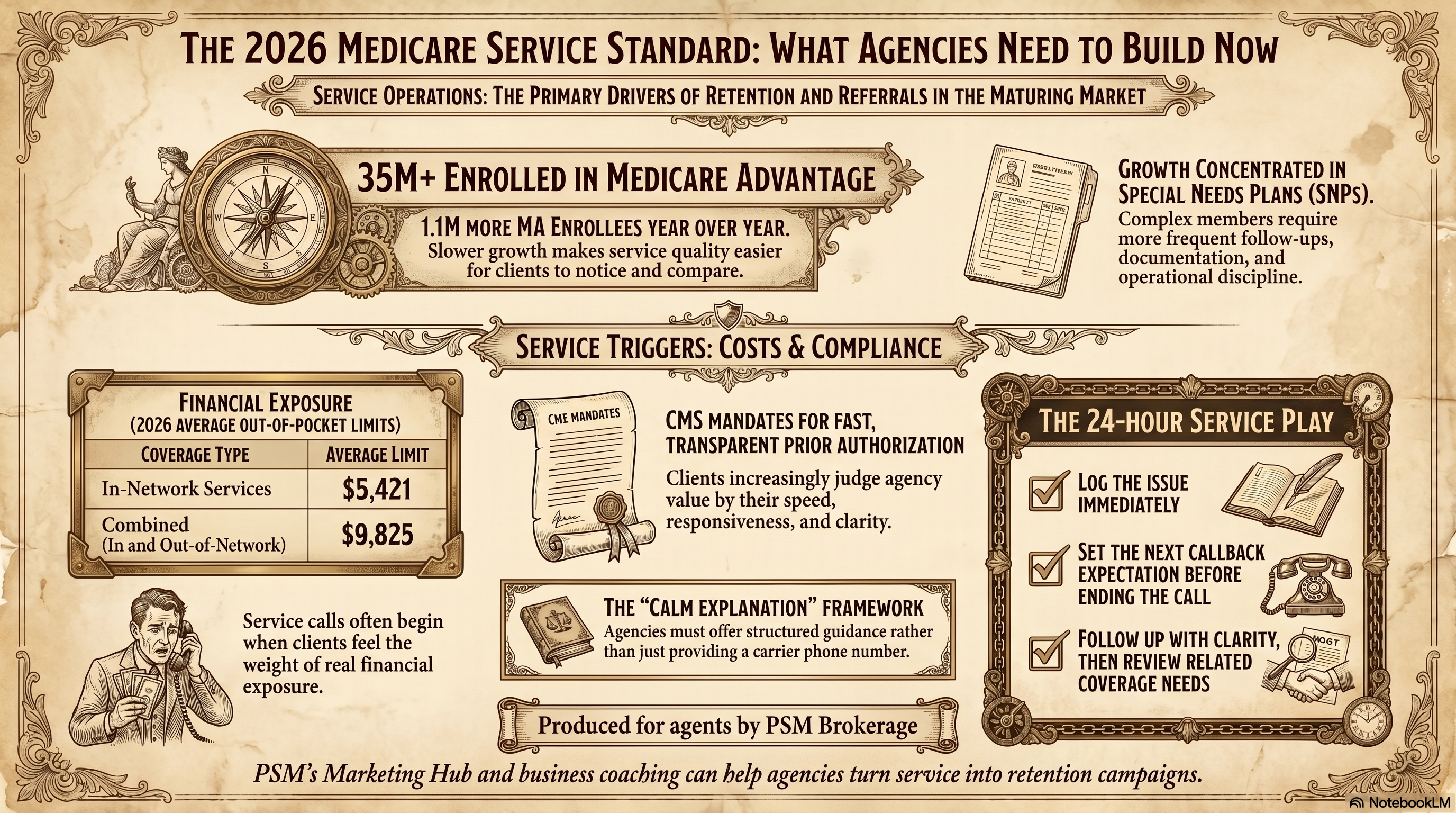
Infographic: https://www.psmbrokerage.com/hubfs/The%20Insurance%20Producers%20Guild/EP14_Infographic.png
Slides: https://www.psmbrokerage.com/hubfs/The%20Insurance%20Producers%20Guild/EP14_Slides.pdf
✅ Go-Do
This week, create a simple service response standard for your agency and test it on your next five service calls.
• Define your intake process
• Set a clear callback commitment
• Document every client interaction
• Follow up after the issue is resolved
🔗 Sources
- Medicare Advantage enrollment grew by about 1 million people in 2026, mainly due to Special Needs Plans — KFF
https://www.kff.org/medicare/medicare-advantage-enrollment-grew-by-about-1-million-people-mainly-due-to-special-needs-plans/ - CMS Interoperability Standards and Prior Authorization for Drugs (2026 Proposed Rule) — CMS.gov
https://www.cms.gov/priorities/burden-reduction/overview/interoperability/policies-regulations/cms-interoperability-standards-prior-authorization-drugs - Medicare Advantage Out-of-Pocket Limits: Variation and Trends (2026) — KFF
https://www.kff.org/medicare/medicare-advantage-out-of-pocket-limits-variation-and-trends/
The Insurance Producers Guild Podcast delivers intelligence for insurance agents looking to stay ahead of industry trends.
Follow the show and connect with PSM Brokerage to access tools, training, and support designed to help you grow your business.
Learn more: https://www.psmbrokerage.com
You know, there's a a very specific um deeply uncomfortable feeling you get when you're running an independent insurance agency today in 2026.
SPEAKER_01Aaron Powell Oh, yeah. I know exactly what you mean.
SPEAKER_00Aaron Powell Right. Because enrolling people, I mean, that's the part you already know how to do. You're sitting at the kitchen table, the presentation is smooth, the logic is totally sound, and the paperwork gets signed.
SPEAKER_01Exactly.
SPEAKER_00The easy part. Right. But then, you know, maybe three or four months later, the phone rings.
SPEAKER_01Aaron Powell And it is definitely not a new prospect on the line.
SPEAKER_00Aaron Powell Not at all. It's a client and they are just in a total panic. There's uh a delay getting a critical drug or maybe an access issue at a specialist, or they just open some, you know, surprise denial letter in the mail, and suddenly all that immense confidence you had during the initial sale, it just totally evaporates.
SPEAKER_01It's the worst feeling.
SPEAKER_00It really is. The post-sale service side of the business can feel so incredibly reactive. You're scrambling, you're uh looking up carrier portals, and honestly, you start to sound like you're just guessing rather than actually guiding them.
SPEAKER_01Aaron Powell, which is a terrifying place to be for any business owner because, well, trust is incredibly fragile.
SPEAKER_00Yeah.
SPEAKER_01But we are going to dissolve that exact fear over the next few minutes. Because today, we're looking at everything through the agency builder lens.
SPEAKER_00I love that.
SPEAKER_01Our entire mission for this deep dive is really about creating a simple, repeatable service operating system. Because the goal is to make your small agency feel remarkably fast, completely clear, and just absolutely dependable to the people relying on you.
SPEAKER_00Welcome to this deep dive on the Insurance Producers Guild. This is produced by PSM Brokerage. And we've got a strict rule for a time together today, right? Every single piece of empirical data we discuss is going to be translated into a concrete lesson for you.
SPEAKER_01We're breaking it all down.
SPEAKER_00Yeah, we'll cover exactly what to understand, what to say, and what you need to build in your agency this week.
SPEAKER_01No high-level theory, just practical application for your book of business.
SPEAKER_00So let's start by looking at why service has fundamentally become a growth issue. We've got to begin here because before we can build, you know, the actual service frameworks, we have to understand the massive empirical shift in who is actually calling the agency right now.
SPEAKER_01Aaron Powell Which is huge.
SPEAKER_00It is. I was digging into the latest macro data from KFF, and the numbers are just massive. As of February 2026, Medicare Advantage hit just over 35 million enrollees.
SPEAKER_01Aaron Powell It's just a staggering footprint when you consider the sheer volume of claims that it represents.
SPEAKER_00It really is. And the market grew by about uh 1.1 million people, which is a 3% year-over-year increase. But here's the crucial nuance in that data, right? Much of this new growth isn't coming from standard plans.
SPEAKER_01No, it's not.
SPEAKER_00It's being driven heavily by special needs plans, particularly dual eligibles. And look, I have seen this pattern before. Oh, for sure. If you look back at the fast growth eras of the past, think about like the early 2010s, a massive influx of easy, straightforward enrollments could easily hide weak agency service.
SPEAKER_01Aaron Powell Absolutely. The rising tide lifts all boats.
SPEAKER_00Exactly. But slower growth exposes the rocks. Today, we're in a mature, highly competitive market, and your service quality is fully exposed to the client.
SPEAKER_01Aaron Powell And mechanically, what that shift towards special needs plans actually means for your daily operations is pretty profound.
SPEAKER_00Aaron Powell Yeah. Unpack that for us.
SPEAKER_01Aaron Ross Powell Well, what's fascinating here is that a complex SNP client, especially someone who is dual eligible, naturally requires significantly more ongoing guidance. Aaron Powell Right. Think about the mechanical friction of having both Medicare and Medicaid. You're dealing with two completely disparate bureaucracies. Trevor Burrus, Jr.
SPEAKER_00Right. One federal, one state.
SPEAKER_01Trevor Burrus, Jr. Exactly. And they don't always talk to each other seamlessly.
SPEAKER_00Aaron Powell No, they definitely don't. And I'm glad you brought up that friction because when you have a dual eligible client, the mechanical breakdown usually happens at the provider's billing department.
SPEAKER_01Oh, all the time.
SPEAKER_00A doctor bills Medicare, Medicare pays its portion, but then the billing office just fails to route the remainder to the state Medicaid program correctly. Yep. So suddenly a low-income senior gets a balance bill in the mail for like hundreds of dollars. And they're terrified.
SPEAKER_01Aaron Powell And who do they call?
SPEAKER_00Right.
SPEAKER_01I mean, they don't call the hospital's billing department, and they rarely call the 1-800 number on the back of the card. They call the agent who sat at their kitchen table and made a promise to them.
SPEAKER_00Yep.
SPEAKER_01Complex clients need more touch points, and this is where agencies quietly lose clients.
SPEAKER_00Wow. Yeah.
SPEAKER_01The sale was successful, but the agency lacks the operational discipline, you know, the documentation habits and the review cadence to support that client long term. So true. When those complex beneficiaries feel abandoned during a crisis, they'll absolutely seek help from another broker.
SPEAKER_00I hear that, but let me push back a bit here on behalf of the listeners. Sure. If I'm running a small shop, and maybe it's just me and like one administrative assistant, how am I supposed to manage that level of intense ongoing hand holding without completely derailing my acquisition efforts? Right. I mean, we can't staff a full-time call center just to fix provider billing errors.
SPEAKER_01No, and that's a completely fair challenge. It can feel like a heavy lift, but it doesn't have to be entirely manual.
SPEAKER_00Okay.
SPEAKER_01You have to stop treating client communication as like back office administrative trivia and start treating it as a core growth strategy.
SPEAKER_00I like that.
SPEAKER_01To support this mature market, PSM brokerage agents can utilize marketing hub assets.
SPEAKER_00Right.
SPEAKER_01This allows you to automate the baseline retention touch points. So newsletters, birthday check-ins, educational drip campaigns about how billing works without completely overwhelming your small staff. Trevor Burrus, Jr.
SPEAKER_00That makes sense.
SPEAKER_01Yeah, you let the system do the heavy lifting of staying visible. So your actual human capital is reserved for those high value friction points like the panic call you just described.
SPEAKER_00Okay. So we're talking about shifting the human effort to where it actually counts.
SPEAKER_01Exactly.
SPEAKER_00Because there's another layer to this. The government is fundamentally changing the definition of how fast that human effort actually needs to be.
SPEAKER_01Oh, the clock is speeding up across the entire industry.
SPEAKER_00It really is. Let's look at the CMS mandate. In May 2026, CMS laid out a major proposal regarding interoperability standards and prior authorization for drugs. Right. And the timeline they've set is aggressive. By October 2027, impacted payers are being pushed toward electronic prior authorizations, significantly faster decision timeframes, and just total transparency in the process.
SPEAKER_01Aaron Powell They want the analog friction completely gone.
SPEAKER_00Yeah. But honestly, so what does this all mean? When I first read payer IT rule, my eyes kind of glazed over. Sure. Because if I'm an independent agent, why do I care about a carrier's interoperability standards? I don't manage clinical prior authorizations myself. I'm not the medical director stamping the approval, right?
SPEAKER_01Right. But you care because of the psychology of speed and consumer expectation. Oh if we connect this to the bigger picture, let's break down the mechanics of this interoperability standard. Historically, a prior authorization meant a doctor's office faxed a stack of paperwork to a carrier, it sat in the queue for days, and eventually, maybe someone reviewed it.
SPEAKER_00Right, the black hole.
SPEAKER_01Exactly. CMS is forcing a shift to system-to-system API connections. Think of it like TSA pre-check for healthcare.
SPEAKER_00Oh, that's a great analogy.
SPEAKER_01We are moving from a manual, confusing pat downline to a streamlined digital clearance process where systems just talk to each other instantly.
SPEAKER_00And once people experience TSA pre-check, they refuse to tolerate the regular line ever again. Exactly. It resets their baseline expectation for literally everything else in the airport.
SPEAKER_01Precisely. The broader healthcare ecosystem is shifting entirely to digital era speed. As those payer systems get faster and more transparent, beneficiaries are going to increasingly expect their agent to be just as responsive. Right. You can't be the slow analog agent in a digital API-driven healthcare system.
SPEAKER_00Aaron Powell The shops that run a clean service game keep the book.
SPEAKER_01Aaron Powell That's the reality of the 2026 market. Clients are simply no longer going to accept an agent who answers a panic call by saying, Ah, I don't really know, call the carrier and see what they say. Right. That error is totally over.
SPEAKER_00Aaron Powell So what's the playbook for the agency then? Because if the expectation is instant digital speed, how does a human agent with a ringing phone match that without just burning out?
SPEAKER_01You need to install what we call the 24-hour service play.
SPEAKER_00Okay.
SPEAKER_01It consists of four non-negotiable steps: intake, documentation, clean handoff, and callback. Got it. And here's a critical rule for this play. Never, ever criticize the carrier partners to the client. Do not throw the plan under the bus.
SPEAKER_00Aaron Powell Oh, but it's so tempting though. No, when the client is furious about a delay, the easiest thing in the world is to just join them and say, Yeah, carrier X is terrible at this. I'm so sorry. It feels like you're building rapport.
SPEAKER_01It feels like rapport, but it actually destroys your credibility. Remember, you put them in that plan. If you trash the carrier, you're retroactively trashing your own recommendation.
SPEAKER_00Oof, that's true.
SPEAKER_01Instead, you treat this friction purely as a changing healthcare system that good agencies just navigate better. You position yourself as the expert guide through a complex landscape.
SPEAKER_00All right, I like that framing, but let's talk about the actual implementation here.
SPEAKER_01Sure.
SPEAKER_00If my phone is ringing off the hook during AEP or a busy season, what is the actual phrasing top-tier agencies are pivoting to when a client calls stressed about, say, a prior authorization delay?
SPEAKER_01Write this down. Here's what I would say to the client. When they call, you say, I hear your frustration about this prior authorization delay, and we are going to get to the bottom of it together.
SPEAKER_00Okay, good start.
SPEAKER_01Here is our process. I am documenting your concern right now. While you are on the line, we are going to conference in the carrier to get the exact tracking status. Hi. And then I will personally call you back tomorrow at 2 p.m. with our next step. You are not navigating this alone.
SPEAKER_00Man, let's analyze the psychology there because you are not navigating this alone completely changes the temperature of the conversation. It does. You aren't just reacting, you're taking immediate ownership. Empathy first, immediate action with the documentation, collaborative escalation by conferencing the carrier, and a really rigid follow-up commitment. But let me challenge that 2 p.m. callback guarantee. What if we conference the carrier and they give us absolutely no new information? What if the issue isn't actually resolved by 2 p.m. tomorrow?
SPEAKER_01You still call at 2 p.m.
SPEAKER_00Really?
SPEAKER_01Yes. The callback isn't about having the perfect solution. It's about proving dependability. Okay. You call at 2 p.m. and say, I promised I'd update you. We are still waiting on the medical director, but I am tracking it, and I'll call you again on Thursday at 10 a.m.
SPEAKER_00Ah.
SPEAKER_01The consistency of the system is what lowers their blood pressure. And by the way, if an agency feels overwhelmed trying to build this process internally, PSM business coaching can actually step in to help install these exact repeatable service systems.
SPEAKER_00That's a great resource. Yeah.
SPEAKER_01So your office runs like a well-oiled machine rather than a reactive scramble.
SPEAKER_00That's the difference between a transactional business and a true operating system. And you know, once you have that system in place, once you can quickly resolve the initial panic of an access delay, you start to uncover what the client is actually terrified of underneath it all. It's rarely just the paperwork.
SPEAKER_01It's the fear of the unknown bill.
SPEAKER_00Exactly. Let's look at the financial exposure data from KFF. In 2026, the average Medicare advantage out-of-pocket limits are, well, they're real substantial money.
SPEAKER_01Yes, they are.
SPEAKER_00We're talking $5,421 for in-network and a staggering $9,825 combined. Here's where it gets really interesting. When a client calls you furious about a delay or a denial, they aren't actually mad about the administrative process. They're driven by the absolute fear that their plan isn't working as expected and they're about to be hit with a massive life-altering bill.
SPEAKER_01Aaron Powell, which is completely rational fear when you look at those exposure limits.
SPEAKER_00Right.
SPEAKER_01For a senior on a fixed income, a $5,400 bill isn't just an inconvenience, it's a financial catastrophe. Trevor Burrus, Jr.
SPEAKER_00Completely rational. And stepping into that exact moment of fear with a calm, structured benefit review framework is what separates a transactional salesperson from a lifelong trusted advisor. You're catching them when they feel the most vulnerable and you're providing absolute clarity.
SPEAKER_01And this raises an incredibly important question about how we handle cross-selling. Because there's a golden rule in agency building. Yeah. You never sell before you solve. Never.
SPEAKER_00No, because if you pitch too early, you just sound like an opportunist.
SPEAKER_01Exactly.
SPEAKER_00If someone is terrified about a bill and you immediately try to sell them another policy, you lose the trust instantly.
SPEAKER_01Aaron Powell, you do. If they're calling about a billing issue, you don't immediately pivot to pitching a new product. You solve the immediate pain point cleanly and efficiently. Right. You only uncover legitimate ancillary needs like hospital indemnity, cancer, dental life, or ACA products after the initial issue is entirely resolved.
SPEAKER_00Makes total sense.
SPEAKER_01But once you have solved the issue, you've earned the right to have a broader conversation about their comprehensive financial protection. You've proven your value in the Frenches.
SPEAKER_00So take us into the mechanics of that transition. How do we move from solving a service issue to actually uncovering a legitimate cross-cell need without breaking that trust?
SPEAKER_01This is how service turns into retention and referrals. Write this down. Once the initial problem is completely sorted out, here's the phrasing you can adapt.
SPEAKER_00Okay, I'm ready.
SPEAKER_01Now that we have this billing confusion sorted out with the carrier, I want to protect you from this stress in the future.
SPEAKER_00Wow, that's a great pivot.
SPEAKER_01Right. Then you say, I noticed your plan has that $5,421 out-of-pocket maximum we originally discussed. Many of my clients use a simple hospital indemnity plan to cover that exact gap so a surprise hospital stay doesn't drain their savings.
SPEAKER_00Perfect.
SPEAKER_01Let's take 10 minutes to review how that works.
SPEAKER_00Love that.
SPEAKER_01And by the way, if you have friends at the senior center who are just as confused by their Medicare mail right now, please give them my number. I am happy to help decode it for them, exactly like we did for you today.
SPEAKER_00I want to pause on that anchor phrase. I want to protect you from this stress in the future. It's just so seamless.
SPEAKER_01It really is.
SPEAKER_00You aren't pitching a product out of thin air. You're pitching peace of mind based on real empirical data from their current plan. You're attaching the solution to the visceral emotion they just experienced.
SPEAKER_01And the referral ask is just as natural.
SPEAKER_00Yeah.
SPEAKER_01You aren't begging for leads. You're offering to be a resource for their community. You're positioning yourself as the person who decodes confusion, who doesn't want to share that kind of valuable resource with their friends.
SPEAKER_00Exactly. And obviously, as you start building out these broader service and cross-sell campaigns based on these plays, you want to make sure your messaging is entirely compliant.
SPEAKER_01Oh, absolutely.
SPEAKER_00As a reminder, PSM Compliance and Legal can review your outreach language before it goes out, ensuring everything you're sending to clients is airtight and fully compliant with the latest regulations.
SPEAKER_01Which is just another way to protect your business while you focus on growth.
SPEAKER_00So let's tie all these threads together for you. What we're seeing in 2026 is that slower Medicare Advantage growth means your service essentially is your marketing. You can't just rely on an endless wave of new enrollments to mask a leaky bucket.
SPEAKER_01No, you really can't. And second, CMS is making speed and transparency the new standard. Your agency has to reflect that same level of digital era responsiveness, even over the phone.
SPEAKER_00Right. And finally, solving those out-of-pocket feels rather than avoiding them or passing the buck is your ultimate gateway to verified ancillary cross-sells and deep client retention.
SPEAKER_01The problem isn't a distraction from your business, the problem is the business.
SPEAKER_00Well said. So here's a concrete action for you to take in your agency this week.
SPEAKER_01Do it.
SPEAKER_00I want you to audit the last three service calls your agency took. Just look back at them honestly. Did you guide the client with a clear, rigid callback timeline? Or did you just passively pass them off to a 1-800 number and hope for the best?
SPEAKER_01Be honest with yourself. Yeah.
SPEAKER_00By this Friday, I want you to type out your own version of that 24-hour intake script framework we discussed and physically tape it to your desk.
SPEAKER_01Make it the standard operating procedure for everyone who picks up a phone in your office.
SPEAKER_00Because at the end of the day, when that phone rings and a panicked client is on the line, you don't want to be guessing. You want to be guiding.
SPEAKER_01Exactly.
SPEAKER_00Which leaves us with one final thought for you to mull over as you look at your growth strategy for the coming years. Yeah. We spend all our time discussing technology, interoperability, and digital speed. But if system-to-system APIs and artificial intelligence eventually get so good that they can resolve basic carrier administrative tasks instantly by the 2030s, what happens to your agency?
SPEAKER_01That is the real existential question right there.
SPEAKER_00If your agency is nothing more than a transaction hub for paperwork, an algorithm will eventually replace you. But if you master the human empathy step, the ability to sit with a terrified senior, look them in the eye, and say, you are not navigating this alone. That's the one thing Silicon can never replicate.
SPEAKER_01Never.
SPEAKER_00Human trust might just be the only unbreakable moat your agency has left.