
The Insurance Producers Guild
The Insurance Producers Guild is a strategic briefing for insurance professionals, focused on Medicare, ACA, life insurance, and the evolving insurance landscape. Each episode distills complex industry changes into clear, practical intelligence.
AI was used in the making of these podcasts.
The Insurance Producers Guild
EP16 Navigating the AI Ocean as an Insurance Agent
Use Left/Right to seek, Home/End to jump to start or end. Hold shift to jump forward or backward.
📝 Episode Description
In this episode of The Insurance Producers Guild, we explain how AI search is changing the way prospects find Medicare, Final Expense, ACA, and annuity agents.
As consumers turn to ChatGPT, Google AI, and review platforms for recommendations, agents need stronger digital trust signals. This episode breaks down what changed and gives agents a simple three-step audit to improve visibility, credibility, and lead flow.
🔑 Key Topics Covered
AI search and its impact on agent discovery
Google Business Profile reviews and online trust signals
Why agent bios, photos, LinkedIn links, and updated service pages matter
How PSM Brokerage resources help agents execute the fixes
🎯 What This Means for Agents
AI search is becoming part of the prospect journey
Reviews and recent activity can influence credibility
Clear agent identity and updated website content matter more than ever
Small digital fixes can help agents stay visible and competitive
📌 GO-DO: Three-Fix Audit
This week:
- Check your Google Business Profile. If you have fewer than 50 reviews or no review in the last 60 days, ask three happy clients for a review.
- Update your About or Agent Bio page with your real name, photo, and LinkedIn link.
- Add “Updated June 2026” to your main service page and refresh one paragraph.
Use PSM Brokerage Marketing Hub templates, Compliance review, and Business Coaching to get it done.
Infographic: https://www.psmbrokerage.com/hubfs/The%20Insurance%20Producers%20Guild/IPG_EP16_Infographic.png
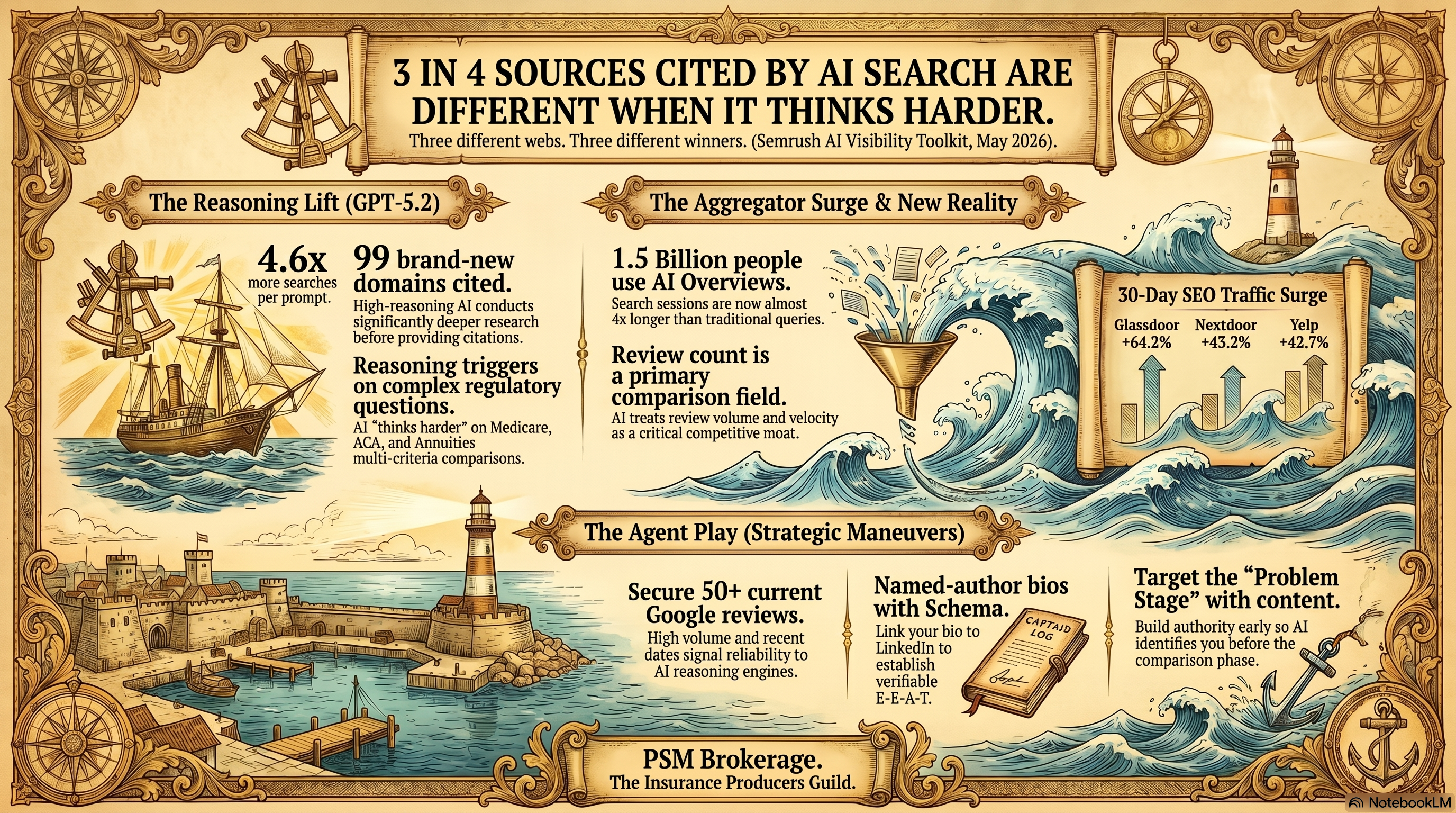
Slides: https://www.psmbrokerage.com/hubfs/The%20Insurance%20Producers%20Guild/IPG_EP16_Slides.pdf
🔗 Sources
Growth Memo by Kevin Indig — Reasoning Lift: What Happens to AI Visibility When AI Thinks Harder
https://www.growth-memo.com/p/reasoning-lift-what-happens-to-ai
Growth Memo by Kevin Indig — Growth Intelligence Brief #19
https://www.growth-memo.com/p/growth-intelligence-brief-19
Growth Memo by Kevin Indig — What to Do Now That AIOs Turned Search Into Reading Sessions
https://www.growth-memo.com/p/traditional-intents-can-no-longer
The Insurance Producers Guild Podcast delivers intelligence for insurance agents looking to stay ahead of industry trends.
Follow the show and connect with PSM Brokerage to access tools, training, and support designed to help you grow your business.
Learn more: https://www.psmbrokerage.com
What if I told you that overnight, three out of four websites you used to compete against simply vanished from search results and you were suddenly replaced by a Yelp?
SPEAKER_00I mean that sounds like an absolute nightmare scenario for any independent agent. But you know, the reality is this exact shift is happening right now across the industry. And uh it is entirely winnable if you just know the new rules.
SPEAKER_01Welcome to this bonus episode of the Insurance Producers Guild. Look, we are jumping into a massive stack of critical data today. We're looking at SEMrush and the growth memo reports from May and June of 2026.
SPEAKER_00Aaron Powell Yeah, we're tracking exactly what happens when artificial intelligence decides to think harder about insurance queries.
SPEAKER_01Right. And the mission for you listening today is pretty simple. We are going to name the fear out there in the field, dissect how the AI actually works behind the scenes, and then uh we'll give you a specific checklist to conquer it.
SPEAKER_00Aaron Powell Because right now, there's just this very real anxiety in agency bullpen. Agents are, well, they're terrified of being made completely invisible by a machine they don't control.
SPEAKER_01It's true. You have seniors and increasingly, you know, their adult children opening up ChatGPT or Google AI and simply typing, recommend a local Medicare agent.
SPEAKER_00Yeah, or find a final expense agent near me. And the anxiety comes from the black box nature of it all. You know how to network in your community, right? You know how to buy mail drop.
SPEAKER_01Exactly.
SPEAKER_00But now, if you are not the name the machine spits out in that synthesized answer, you just you simply do not exist to that buyer.
SPEAKER_01Aaron Ross Powell Look, I've been through this. I have over 25 years in this business, and I have seen this exact cycle of panic play out repeatedly.
SPEAKER_00Oh, for sure.
SPEAKER_01I remember carrying massive briefcases full of paper applications in the trunks of our cars, doing everything by hand. And when we transitioned to tablets, agents swore it would destroy the personal relationship. Trevor Burrus, Jr.
SPEAKER_00Right. Because we were staring at screens instead of making eye contact.
SPEAKER_01Exactly. Then I saw the absolute panic when the internet first started generating leads. Half the field thought the local agent was dead. Every single time technology shifts, agents panic. But um the underlying rules of trust remain the exact same.
SPEAKER_00Aaron Powell The trust just takes a new form. And the great irony here is that the authority signals winning in AI search today are actually signals you already control.
SPEAKER_01Yes. You already know how to build trust with your clients in a living room.
SPEAKER_00Aaron Powell We just have to format that trust mathematically so the algorithm can read it.
SPEAKER_01Exactly. The trust has to be translated into data.
SPEAKER_00Aaron Powell So let's break down how this AI actually searches because the underlying mechanism changes everything. Let's look at the May 18, 2026 growth memo data.
SPEAKER_01Right, the SEMrush study. They looked at ChatGPT version 5.2 and they tracked what happens when it shifts from minimal reasoning into high reasoning mode. Right. The researchers essentially monitored the server request the AI made before it generated a response. And when the AI fires up high reasoning, its citation rate jumps from 50% to 68%.
SPEAKER_00Wait, really? 68%? Yeah.
SPEAKER_01It works exponentially harder. It runs uh 4.6 times more internal searches per prompt. The software engineers call these fan out queries.
SPEAKER_00Okay, wait, I need you to explain that mechanism clearly for everyone. What exactly is a fan out query? Think of it this way: under minimal reasoning, the AI is just predicting the next word based on its historical training data. It's essentially guessing based on patterns. Right. But with a fan out query, the AI pauses. It opens up invisible browser tabs in the background. It searches local directories, cross-references, compliance rules, and compares agency histories. Wow. All in a fraction of a second before it types a single word back to the senior.
SPEAKER_01That makes perfect sense. So think of minimal reasoning AI as like a lazy librarian who just grabs the closest encyclopedia on the desk.
SPEAKER_00Yeah. Exactly.
SPEAKER_01But high reasoning AI is a private investigator. It leaves the desk, calls the state medical board, checks your agency background, and verifies your references before it gives the client an answer.
SPEAKER_00That is exactly how it functions. And here is where the SEMRush data reveals the real impact. Under minimal reasoning, the AI pulls from 127 unique domains. Okay. But under high reasoning, it pulled from 173 unique domains. And here is the most critical pattern for you to understand.
SPEAKER_01What's that?
SPEAKER_00Out of those 173 domains, 99 of them never appeared during the minimal reasoning test.
SPEAKER_01Aaron Powell Oh, wow. So three out of four cited websites are completely different.
SPEAKER_00Completely different. Just because the AI switched into private investigator mode.
SPEAKER_01Aaron Powell I have to ask the obvious question though. I mean, does the AI do this for every single search? Because that requires a massive amount of computing power. Trevor Burrus, Jr.
SPEAKER_00No. It doesn't. Trevor Burrus The reasoning mode triggers specifically on multi-criteria comparisons and regulatory questions. Aaron Powell Okay. It doesn't fire when someone just asks for an agency phone number. It fires when a prospect asks how to pick a Medicare plan based on their specific doctors and prescription list. Right. Or it fires when they're comparing ACA options after falling off a subsidy cliff and they need to calculate maximum out-of-pocket costs. Or, you know, when they evaluate a complex annuity choice against mutual funds.
SPEAKER_01So here's the pattern I'm seeing. A hard question leads to a harder search. And that harder search pulls entirely different sources. Let's map out how this actually looks for a senior turning 65. Let's say a prospect named Richard is trying to calculate those maximum out-of-pocket costs.
SPEAKER_00Well, according to the SEMRush study, the AI tracks brand persistence all the way from that initial problem stage to the final selection stage.
SPEAKER_01Okay.
SPEAKER_00They proved this across four distinct buyer journeys in the finance sector. If you are the agent who wrote the clear, accurate article on calculating those exact costs, the AI cites you while Richard is just doing his initial research.
SPEAKER_01Because you provided the underlying data the AI used to build its reasoning.
SPEAKER_00Right. It anchors to your authority.
SPEAKER_01So when Richard comes back three days later and asks the AI which local agent should I call to enroll in this plan, the AI carries your brand straight through to the close. Exactly. Here's the play. Top of funnel content matters again. A lot of agents stopped writing educational articles recently, but the human doesn't even need to read them.
SPEAKER_00No, the bot reads them.
SPEAKER_01Right. The agent showing up at the beginning of the journey at the how do I pick a Medicare plan stage is the one the AI carries to the selection stage.
SPEAKER_00We know the AI is pulling from deeper, more educational sources when reasoning kicks in, but you know, pulling the source is only half the battle. Right. What happens when the senior actually stares at the screen? Because the AI is formatting those results in a completely new way.
SPEAKER_01This is where we have to look at the May 29, 2026 growth memo data. The report tracks 30-day SEO movers.
SPEAKER_00Oh, this data is wild.
SPEAKER_01It is. The massive visibility gains are all going to review aggregators. The numbers are staggering. Yelp is up 42.7%. Wow. Glassdoor is up 64.2%. Trustpilot jumped 39.5%. Nextdoor is up 43.2%.
SPEAKER_00I look at this pattern and it's basically the new yellow pages. When a senior searches for a Medicare agent near them, Google is increasingly routing them directly to Yelp, Google Business, or Nextdoor First.
SPEAKER_01Bypassing the agent's website entirely.
SPEAKER_00Completely bypassing their highly optimized website.
SPEAKER_01Why is the algorithm doing that though? It seems counterintuitive to hide the actual business website.
SPEAKER_00Because the search engines are prioritizing community trust signals. They know the user wants third-party validation, not a corporate sales pitch. Right.
SPEAKER_01That makes sense.
SPEAKER_00Like why Glassdoor? Because if the AI sees you treat your employees well, it factors that into your overall trust score. Nextdoor is the ultimate hyperlocal community trust signal.
SPEAKER_01Oh, definitely. If neighbors are recommending you on Nextdoor, the AI maps that directly to a local search query.
SPEAKER_00Yeah. And this perfectly bridges to the June 1st, 2026 growth memo beta. Over 1.5 billion people are now using AI overviews on Google.
SPEAKER_011.5 billion.
SPEAKER_00Yeah. The AI drops a synthesized answer at the very top of the search page. The researchers call this intent compression.
SPEAKER_01How does intent compression actually change human behavior on the screen? Like what are people doing differently?
SPEAKER_00Well, intent compression means the user's journey from realizing they have a problem to making a decision happens entirely in one single page.
SPEAKER_01Okay.
SPEAKER_00The old rules of search are collapsing. Before, someone would search, click the first blue link, and leave the page. Now user sessions on the search page itself are four times longer.
SPEAKER_01Four times.
SPEAKER_00Yes. Between 42 and 48.5% of users are still sitting on the main search page after 21 seconds. They aren't bouncing around to five different websites anymore.
SPEAKER_01Because the AI has aggregated the five websites for them.
SPEAKER_00Exactly.
SPEAKER_01So they are reading the AI summary and then they scroll down slightly to compare the local listings right there.
SPEAKER_00Yes. This creates a new concept we really need to master today. The second impression.
SPEAKER_01The second impression.
SPEAKER_00They read the synthesized answer and then they look at the local map pack. In this second impression, your review count is no longer just a vanity metric to make you feel good.
SPEAKER_01Right.
SPEAKER_00It is a direct mathematical comparison field. If you have four reviews and the agency next to you has 400, you lose on that second pass, even if your written description is sharper.
SPEAKER_01There is a very specific technical side to this trust as well, right? The AI uses something called named author schema as an EEAT signal.
SPEAKER_00Yeah, EET. That stands for experience, expertise, authoritativeness, and trustworthiness.
SPEAKER_01We need to explain how that works technically. Schema is actual code. It's a structured data format invisible to the human reader, but flashing brightly for the AI bot.
SPEAKER_00Right.
SPEAKER_01When the bot reads that schema code, it links your article directly to your verified professional footprint, like your LinkedIn page. To the AI verifiable identity equals authority.
SPEAKER_00It needs mathematical proof that a licensed real human being wrote the information. It simply will not cite anonymous corporate text.
SPEAKER_01Okay, knowing this data is fascinating, but application is what pays the bills.
SPEAKER_00Absolutely.
SPEAKER_01Let's transition to monetizing these trends today. Grab a pen, folks, because we have a three-fix checklist. These are the exact moves to run this week to secure your visibility. What is fix number one?
SPEAKER_00Fix number one is auditing your Google business profile. If you have under 50 reviews, or um if your newest review is older than 60 days, the AI comparison page will defeat you.
SPEAKER_01That is the mathematical baseline for the bot. Recency is a competitive moat.
SPEAKER_00Yeah, you cannot rely on five-star reviews from three years ago because the machine considers that stale data.
SPEAKER_01I have to push back here though. How do you actually get those reviews without sounding desperate to the client? Most agents feel incredibly awkward asking for a personal favor right after closing a policy.
SPEAKER_00You remove the awkwardness by building it directly into your sales process. It becomes the final step of the transaction. Here's what I'd say word for word on my next client call.
SPEAKER_01Okay, let's hear it.
SPEAKER_00Mrs. Johnson, you said this plan saved you almost $2,000 a year on your premiums. Take 90 seconds right now to leave that exact sentence in a Google review. I will text you the link right now.
SPEAKER_01The timing is the critical part there.
SPEAKER_00Absolutely. You must send the link before you hang up the phone. Yeah. You wait on the line, ask her if she received the text, and guide her through it while the financial value you just provided is fresh in her mind.
SPEAKER_01And if you run a busy agency, you don't have to build all your follow-up systems from scratch. The PSM Marketing Hub provides ready-to-use co-branded review request templates. Oh, that's huge. Yeah, you can plug those directly into your email campaigns so the requests go out systematically after every policy is issued. Let's move to fix number two real bio, real photo, real link.
SPEAKER_00I look at so many agency websites with generic profile pages. They just say licensed agent with a stock photo of a family walking on a beach.
SPEAKER_01Yep, see it all the time.
SPEAKER_00Those pages are completely invisible to the AI.
SPEAKER_01Because they lack the named author schema code we discussed earlier.
SPEAKER_00Exactly. You must use your real name. You need a real professional photo, and you must include a direct link to your LinkedIn profile.
SPEAKER_01It's just a trust signal for the bot.
SPEAKER_00Yeah, most modern website platforms have simple SEO plugins. You just fill out your profile properly and the plugin generates the invisible code. But the name on your website must match the name on your state insurance license and your LinkedIn profile.
SPEAKER_01You want to make it mathematically impossible for the bot to doubt your identity.
SPEAKER_00Right.
SPEAKER_01Let's expand on the third fix. Date stamp and refresh. The June 1 data proves that a 2024 article sitting next to a 2026 article loses every single time.
SPEAKER_00Every time. The AI wants the most current information available because, well, regulatory numbers change every year, right? Your assignment is to pick your most important service page. For most of you, that's your main Medicare page, or your core life insurance landing page. You add a highly visible tag at the very top of the page that says updated, followed by the current month and current year.
SPEAKER_01Wait, I have another pushback here. If I wrote a great article on Medicare basics, the fundamental rules haven't really changed. Why does the AI care if the date says 2024 versus 2026, if the facts are exactly the same? Why can't I just change the date text and leave the article alone?
SPEAKER_00Because of how bot behavior works. The AI uses a mechanism called token matching.
SPEAKER_01Token matching.
SPEAKER_00Yeah. When the AI crawler scans your page, it converts your words into data tokens. If the string of text in the body of your article is identical to the version it scanned two years ago, the semantic weight hasn't changed. Even if you update the date tag at the top, the crawler recognizes that the core content tokens are identical. It flags the date change as superficial and ignores your page.
SPEAKER_01That makes perfect sense. The machine knows you just slapped a new cut of paint on a rusty car. So how do we force the AI to register the page as genuinely new?
SPEAKER_00You have to rewrite one full paragraph of the actual text. Update the new Part B premium for the year, or plug in a recent inflation statistic for life insurance.
SPEAKER_01Just one paragraph.
SPEAKER_00Just one paragraph. Changing that one paragraph alters the token sequence enough that the crawler registers the page as genuinely updated content.
SPEAKER_01Maintaining this habit is honestly where most agents fail. They update their site once, get incredibly busy during the annual enrollment period, and then two years go by without a single edit.
SPEAKER_00It happens to everyone.
SPEAKER_01This is exactly where leaning on PSM business coaching makes a massive difference. The coaching team can help you map out a simple 90-day refresh plan for your top web pages.
SPEAKER_00That's a great strategy.
SPEAKER_01Yeah, it just becomes part of your quarterly routine. Every 90 days, you spend 30 minutes updating a paragraph on your core pages so you never fall behind the AI preference for fresh content.
SPEAKER_00It's all about controlling the controllables. If you run these three fixes, you are putting yourself directly in the path of the AI search. Right. You might not control the machine itself, but you completely control the data it consumes. You are feeding it the exact signals of trust it craves.
SPEAKER_01Which brings us right back to our mission today. The AI ocean is not something to fear.
SPEAKER_00No, not at all.
SPEAKER_01It is simply a new set of rules based on the old principles of trust, reviews, and current information. You are fully capable of running these three fixes today. If you fix your Google Business profile, verify your author identity, and refresh your dates, you take control of your visibility.
SPEAKER_00You dissolve that anxiety completely.
SPEAKER_01But before we wrap up, I want to leave you with one final thought to explore on your own. We have talked entirely about how AI reads text and reviews today. What happens when the next evolution of AI isn't just reading text, but analyzing the client's voice stress levels on a phone call and mathematically matching them with an agent whose verified personality perfectly aligns with theirs.
SPEAKER_00Wow, that is wild to think about.
SPEAKER_01The digital footprints and trust signals we are building right now might just become the psychological matchmaking tools of tomorrow. Preparing your data today is preparing for a future we can't even fully see yet.
SPEAKER_00That's this bonus episode of the insurance producers killed. If you're not already with PSM Brokerage, this is the kind of actionable intelligence our agents get. Talk to us about contracting.