
The Insurance Producers Guild
The Insurance Producers Guild is a strategic briefing for insurance professionals, focused on Medicare, ACA, life insurance, and the evolving insurance landscape. Each episode distills complex industry changes into clear, practical intelligence.
AI was used in the making of these podcasts.
The Insurance Producers Guild
EP21 100 Million Need Life Insurance
Use Left/Right to seek, Home/End to jump to start or end. Hold shift to jump forward or backward.
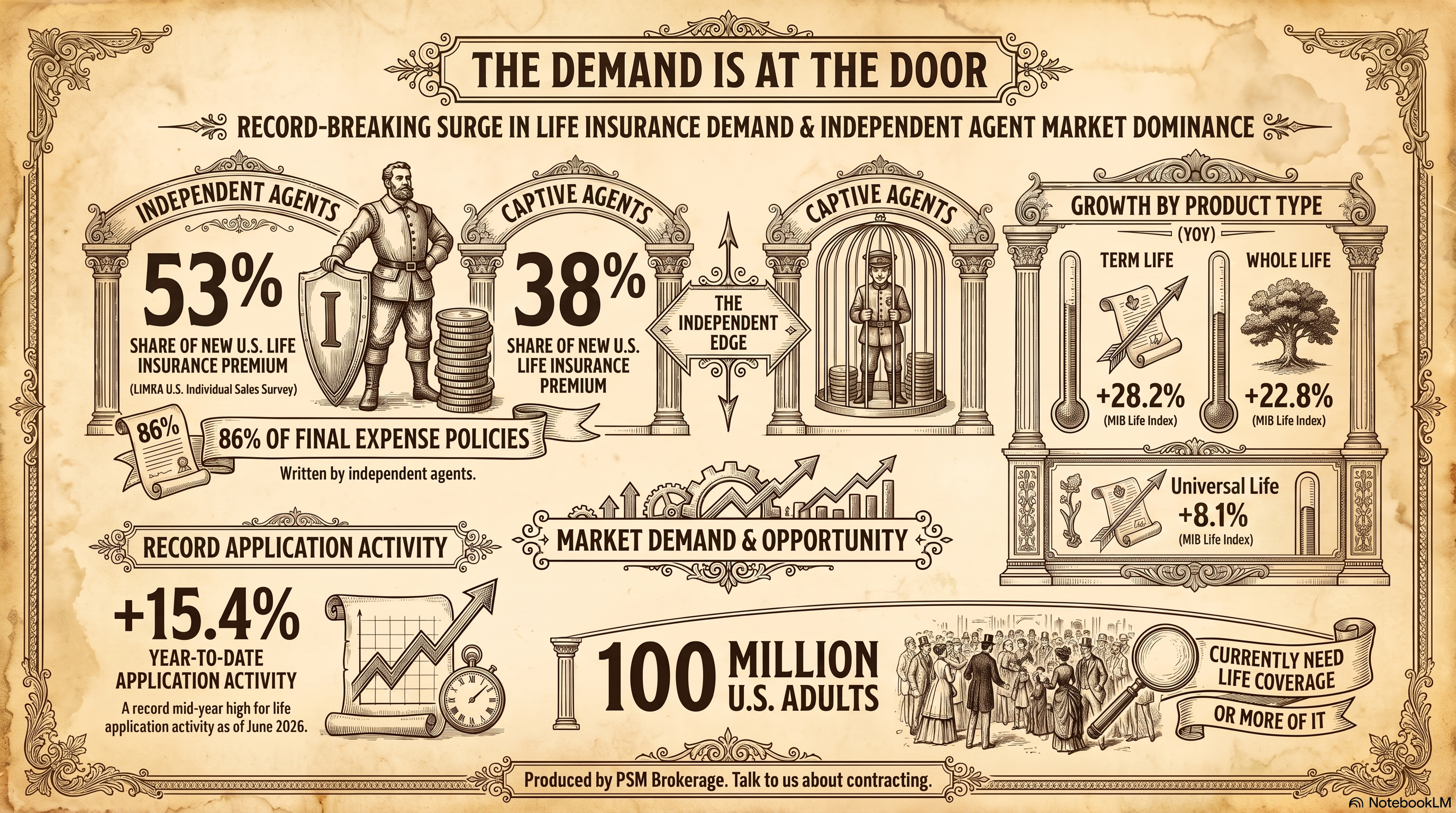
Life insurance demand is reaching record levels. Through mid-2026, U.S. life insurance application activity is up 15.4% year to date, with Term Life and Whole Life both posting strong year-over-year gains. At the same time, nearly half of American adults still lack enough coverage, largely because they overestimate the cost.
In this episode, you’ll Learn why this creates a major opportunity for independent agents. We share a word-for-word response to the “life insurance is too expensive” objection, show how to turn one appointment into two policies, and discuss why independent agents are capturing a growing share of new business.
🔑 Key Topics Covered
- Record life application growth
- Closing affordability objections
- Coverage gap opportunity
- Cross-selling life insurance
🎯 What This Means for Agents
- More prospects are actively seeking coverage.
- Cost misconceptions create consultative sales opportunities.
- Independent agents continue gaining market share.
- Simple cross-sells increase policy count.
🔗 Sources
MIB Life Index:
MIB Life Index
Insurance news Net:
https://insurancenewsnet.com/innarticle/life-insurance-premium-surges-but-coverage-is-still-falling-short-for-many
Life Happens:
https://lifehappens.org/research/they-dont-understand-life-insurance-and-overestimate-its-cost/
📌 GO-DO: Cross-Sell Three Clients
Pull your last 20 Medicare or annuity clients who do not have a life policy with you. Call three this week using: “While I have you, a lot of folks I work with assume life coverage costs way more than it does. Can I run one quick number for you?” Book everyone who says yes.
Infographic:
https://www.psmbrokerage.com/hubfs/The%20Insurance%20Producers%20Guild/IPG_EP21_Infographic.png
Slides:
https://www.psmbrokerage.com/hubfs/The%20Insurance%20Producers%20Guild/IPG_EP21_Slides.pdf
The Insurance Producers Guild Podcast delivers intelligence for insurance agents looking to stay ahead of industry trends.
Follow the show and connect with PSM Brokerage to access tools, training, and support designed to help you grow your business.
Learn more: https://www.psmbrokerage.com
Right now, there are um nearly a hundred million Americans walking around effectively underinsured. Or just completely uninsured.
SPEAKER_01Yeah. Which is a massive number. Trevor Burrus, Jr.
SPEAKER_00It really is. And most of them are assuming life insurance is, you know, some sort of luxury product reserved for the wealthy. Right. Meanwhile, independent insurance agents are sitting in their offices looking at the massive advertising budgets of captive carriers and they are terrified. They worry those giant centralized shops have just stolen all the new business.
SPEAKER_01Aaron Powell Oh, absolutely. It is a really fascinating disconnect, you know. When you look at the stadium sponsorships and the uh endless television commercials from the big captive carriers, it kind of creates this illusion of total market dominance.
SPEAKER_00Yeah, it makes the independent agent feel like a very small fish in a rapidly evaporating pond.
SPEAKER_01Exactly. But the numbers we are seeing right now, they completely dissolve that anxiety. Life insurance applications are currently sitting at record highs. And it is the independent agents, not the captive shops, who are actually writing the vast majority of new life premium.
SPEAKER_00Which is huge.
SPEAKER_01Yeah, the room for independent producers is opening wide, not shrinking.
SPEAKER_00That is the core mission for our analysis today. The market is handing independent agents an incredible, durable opportunity. Definitely. We are going to bring down exactly where this massive influx of new premium is coming from. And more importantly, we are going to look at the exact mechanics of what you need to understand and precisely what you need to say to your clients to capture this momentum this week.
SPEAKER_01I mean, we really need to start with the sheer volume of demand that is sitting right at the front door. We have the numbers to prove that consumer intent is surging, and it is surging right now.
SPEAKER_00Let's look closely at the June 2026 MIB life index for a second.
SPEAKER_01Okay. Yeah.
SPEAKER_00For anyone who might just look at issued policies, it is important to define what this index actually is. The Medical Information Bureau tracks the actual applications submitted to carriers. It monitors the medical underwriting polls.
SPEAKER_01Right. The raw data. Trevor Burrus, Jr.
SPEAKER_00Exactly. That makes this index the ultimate polygraph test for raw consumer demand. People do not, you know, submit to medical questionnaires and underwriting checks just for fun.
SPEAKER_01Aaron Powell No, they certainly do not. It acts as a leading signal. It reflects high-friction shopping behavior before those applications ever actually convert into placed coverage. Right. And the figures in this mid-year report are just staggering. Life application activity ended the first half of the year up 15.4%. Wow. Yeah. That is the highest mid-year total on record. If you compare it to 2024, activity is up 18% overall.
SPEAKER_00Aaron Powell See, the product breakdown is what really caught my eye. Term life applications skyrocketed by 28.2% year over year.
SPEAKER_01Incredible.
SPEAKER_00And whole life applications jumped by 22.8%. I have seen market cycles come and go over the last 25 years, and you rarely see demand this broad.
SPEAKER_01Yeah, it is unusual.
SPEAKER_00When term, whole, and universal life all spike simultaneously, it means the consumer is actively priming themselves. This is not a single carrier through a temporary sale to boost quarterly numbers.
SPEAKER_01Right, it is a rising tide.
SPEAKER_00Exactly. Prospects are sitting at their kitchen tables, worrying about their families and deciding to take action on their own. I have been through this before. When you see demand this broad, it means the consumer is already primed.
SPEAKER_01The consumer mindset has fundamentally shifted. For an agent trying to read the field, the takeaway is entirely practical here. More prospects are raising their hands for life coverage than the market has seen in years. Yeah. So the immediate question is how you monetize that today. Because consumer intent is surging across the board, your first move should not be um buying thousands of dollars in new cold leads.
SPEAKER_00Right.
SPEAKER_01You need to immediately reopen your warm files and your past declines.
SPEAKER_00Okay. I have to push back on that slightly. If an agent spent an hour with a prospect in 2024 and that prospect firmly said they could not afford it, calling them back today just feels like nagging. Agents assume a no from last year is a permanent locked door. Why would that same person suddenly be receptive now?
SPEAKER_01Because they did not say no to life insurance. They said no to the financial pressure they felt in that specific moment. Think of a warm file like a boiler. Last year, the internal pressure just was not high enough to force a decision. The perceived cost outweighed their immediate anxiety. Today, with inflation, shifting economic realities and, well, getting a year older, that internal pressure has built up. They are already thinking about it. You just have to be the one to open the valve.
SPEAKER_00That makes a lot of sense, actually. The external market factors have changed their internal math.
SPEAKER_01Yeah.
SPEAKER_00So um what is the actual script? How do you open that valve without sounding desperate for a sale?
SPEAKER_01You normalize their past hesitation while creating immediate urgency. You pick up the phone and say, I'm calling because the market has shifted recently. A lot of my clients who paused on getting coverage last year are suddenly locking it in right now.
SPEAKER_00Oh, nice.
SPEAKER_01I want to take just 10 minutes to see what your options look like today so you don't miss out on current pricing.
SPEAKER_00That is really good. You are telling them they are part of a larger trend. Yeah. You remove the stigma of their previous decline by showing them that everyone else who waited is now taking action. It gives them social permission to change their mind.
SPEAKER_01Precisely. The demand is spread across the exact product lines you already sell. You just have to be willing to make the call.
SPEAKER_00But this brings us to a, well, a massive contradiction in the data.
SPEAKER_01Yeah.
SPEAKER_00If application activity is breaking records and people are actively shopping to the point where the MIB index is hitting all-time highs, why is there still a massive untouched coverage gap in the United States?
SPEAKER_01That is a crucial tension of this entire market cycle. The demand we just talked about sits directly on top of a gap that has remained remarkably stubborn. Right. According to the 2026 Insurance Barometer Study from Limerah and Life Happens, roughly half of American adults own a life insurance policy. That leaves roughly 100 million adults who report that they either have no coverage at all or they simply do not have enough to protect their families.
SPEAKER_00100 million people. That is just staggering. Every single Medicare or annuity client sitting in an independent agent's book of business represents a warm life insurance conversation waiting to happen. Oh, absolutely. They already know the agent. They already trust the agent's advice on their health coverage or retirement. But how do you actually monetize this when the client's knee-jerk reaction is always that coverage costs too much?
SPEAKER_01Well, what makes this a durable growth opportunity rather than a permanently closed market is the actual root cause of the gap.
SPEAKER_00Okay.
SPEAKER_01The Limer research repeatedly points out that the barrier is not disinterest. People are not opting out on purpose. Life insurance remains one of the least understood financial products available. The true barrier is pure confusion and severe cost overestimation.
SPEAKER_00I see the cost overestimation constantly, especially with younger, healthy applicants. But why is the assumption always so inflated? People who have never actually priced the term policy tend to assume it costs far more than carriers actually charge.
SPEAKER_01It comes down to anchoring. Consumers naturally anchor their expectations to the insurance products they interact with most often. Aaron Powell Like car insurance. Exactly. They look at their health insurance premiums or their auto insurance premiums, which can cost hundreds of dollars every single month. They assume life insurance operates on that exact same risk math. Right. They psych themselves out of even asking for a quote because they assume they need to be wealthy to afford the protection.
SPEAKER_00That gap between what they assume the premium is and what the coverage actually costs is the exact space where an independent agent earns their commission.
SPEAKER_01Yes, it is.
SPEAKER_00But let's get down to the kitchen table.
SPEAKER_01Yeah.
SPEAKER_00How do you get past that initial barrier? When you bring up life insurance and the client's knee-jerk reaction is, um, you know, I know I need it, but it's just too expensive. How do you dismantle that assumption?
SPEAKER_01Aaron Powell That is the single most common objection in the industry. When they bring up cost, your first instinct might be to argue or immediately throw numbers at them. Sure. You cannot do that. You have to validate their fear first, then reframe it. You say, I completely understand. Most people I sit down with think life insurance costs three to four times what it actually does.
SPEAKER_00Aaron Powell Oh, that is a great opening.
SPEAKER_01Aaron Powell Right. And then you say, but let me ask you: if we could secure a policy that protects your family for less than you spend on your monthly streaming subscriptions, would you at least want to see the actual math?
SPEAKER_00Aaron Powell I see what you're doing there. You are taking this massive abstract fear of financial ruin and anchoring the solution to a trivial everyday expense.
SPEAKER_01Aaron Powell Exactly.
SPEAKER_00But what happens if you are sitting with a senior for a final expense policy and they say, Well, I barely watch TV. I don't have streaming subscriptions.
SPEAKER_01Aaron Powell You adjust the anchor to fit their reality, you pivot to whatever small discretionary spending they relate to. Okay. You say, if we could secure this for less than the cost of one tank of gas a month, or um less than going out to dinner once a month, the specific anchor does not matter as long as it grounds the abstract fear into a highly manageable monthly number.
SPEAKER_00That is really smart.
SPEAKER_01Once they agree to look at the math, you strip away their inflated assumptions. You show them that for a healthy applicant, we are talking about a utility bill, not a luxury expense.
SPEAKER_00It is entirely about breaking down the wall of confusion. Yeah. And once an agent knows how to systematically handle that cost objection, the next step is recognizing who's actually positioned to close these gaps.
SPEAKER_01Right.
SPEAKER_00If we connect this back to our opening point, it is not the captive agencies scooping up this new business.
SPEAKER_01Aaron Powell The Limerae U.S. Individual Sales Survey proves this definitively. Independent distribution now writes 53% of all new life premium.
SPEAKER_00Wow. Over half.
SPEAKER_01Yeah. Compare that with just 38% from affiliated or captive agents. Independent distribution has moved past being the challenger channel. It is now the dominant leader for U.S. life insurance.
SPEAKER_00And in certain product lines, that tilt becomes an absolute landslide. Lemaray reported that independent distribution sold 86% of final expense policies.
SPEAKER_01That is just a massive share.
SPEAKER_00When a senior buys a small whole life policy to cover funeral and final costs, an independent agent is writing it roughly six times out of seven. That is total dominance of a specific demographic.
SPEAKER_01We have to ask why that dominance exists, though. Seniors on fixed incomes want options. They do not want to be forced into a single carrier's rigid underwriting box by a captive agent who only has one product to sell.
SPEAKER_00Right. Because if they get declined, that is it.
SPEAKER_01Exactly. If a captive agent's single carrier denies a client due to a specific health condition, that captive agent has to walk away. An independent advisor can look at multiple carriers, navigate the different underwriting niches, and find the exact right fit for that specific health profile and budget.
SPEAKER_00That flexibility is why policy counts have increased every single quarter since 2022.
SPEAKER_01Yes.
SPEAKER_00Karen Terry from Lemera noted that the industry went through decades with essentially zero policy growth, but the final expense boom is still going strong, and it is acting as a massive driver of whole life growth. Independent agents are out there solving highly specific problems for seniors.
SPEAKER_01Which brings us directly to field execution.
SPEAKER_00Okay.
SPEAKER_01The demand is at the door, the independent channel is winning the lion's share of the business, and you know how to handle the cost objection. Now you need a specific cross-cell technique.
SPEAKER_00This is where a lot of agents stumble, I think.
SPEAKER_01They really do. You need to know how to seamlessly turn a routine Medicare review into a second policy during the exact same appointment.
SPEAKER_00Yeah, they finish updating a client's health coverage and they want to pivot to life insurance, but it feels forced.
SPEAKER_01Right.
SPEAKER_00It triggers the client's defense mechanisms because it suddenly feels like a heavy sales pitch. Walk us through the mechanics of that transition.
SPEAKER_01The secret is that you never position it as a new sale. You position it as an administrative review of their existing protection.
SPEAKER_00Okay, I like that.
SPEAKER_01After you finish the primary business regarding their Medicare or annuity, you start packing up your bag or closing your folder.
SPEAKER_00The physical cue.
SPEAKER_01Yes, this physical action signals to the client that the sales portion of the meeting is over, their guard drops. As you are closing the folder, you casually say, We have your health coverage completely updated for the year. And then you add, while I still have your file open, many of my clients also have me quickly check their final expense or life coverage just to make sure recent inflation hasn't created a gap in their protection.
SPEAKER_00Wow, that is smooth.
SPEAKER_01It only takes about five minutes to review. Do you know exactly how much your current policy will pay out today?
SPEAKER_00That is an incredibly strategic pivot. You are leveraging the trust you just built, updating their health plan. By framing it around inflation, you are not selling them a new product. You are offering to protect the value of the product they already own.
SPEAKER_01Exactly. If they say they do not have a policy, the door is wide open. If they do have one, you get to review it and look for gaps.
SPEAKER_00And you are executing this while they are already in a mindset focused on their health and their future planning.
SPEAKER_01Yeah. And the beauty of this entire strategy is that you do not have to build the infrastructure to support it yourself. Right. You can execute this flawlessly using verified resources from PSM brokerage. If you want to put yourself in front of this exact demographic, utilizing PSM Lead Vendor Partnerships allows you to target this specific demand efficiently.
SPEAKER_00The logistics behind the presentation matter just as much as the script. When you are sitting at that kitchen table trying to overcome the cost overestimation we discussed earlier, you can pull co-branded collateral straight from the PSM marketing hub.
SPEAKER_01Oh, that makes a huge difference.
SPEAKER_00Having professional, compliant materials to visually show clients the true cost of coverage makes your presentation undeniably stronger. It takes your verbal analogy about the streaming subscription and backs it up with clear visual facts right in front of them.
SPEAKER_01Speed is the other critical factor.
SPEAKER_00Definitely.
SPEAKER_01When you are dealing with a market moving this quickly and applications hitting record highs, speed to market is everything. Utilizing PSM contracting support ensures an agent is appointed quickly across the specific carriers that are winning this independent business.
SPEAKER_00Because you cannot afford to let administrative delays cost you a placement when a client is finally ready to sign.
SPEAKER_01Absolutely not.
SPEAKER_00You need the back office engine to support the field technique. The applications are demonstrably there. The hundred million person coverage gap is real and waiting to be closed. And the embedded channel is dominating the field.
SPEAKER_01Yeah.
SPEAKER_00This is not a temporary spike or a short-term trend. The market is handing independent agents a durable multi-year growth cycle.
SPEAKER_01The demand is quite literally at the door, and the door opens toward you. It is entirely up to you to walk through it.
SPEAKER_00Let's summarize the core reality we have analyzed today. Life applications are breaking media records, with term and whole life seeing massive double-digit growth. Right. We have nearly 100 million adults walking around with a coverage gap caused by simple confusion and severe cost overestimation anchored to the wrong financial metrics. And independent agents are the ones capturing the majority of the new premium, writing 86% of the final expense market because they offer the choices consumers actually want.
SPEAKER_01Before we wrap up, I want to leave you with a final thought to mull over as you prepare for your appointments this week. Think about how much potential premium is sitting completely untouched in your own filing cabinet right now simply because you assumed a past client was no longer interested. That is a powerful thought. The market has fundamentally changed over the last two years. Your past clients' financial anxieties have changed right along with it. The people who told you no a year ago might be sitting at their kitchen tables today just waiting for someone to help them make sense of the math.
SPEAKER_00That's this episode of the Insurance Producers Guild. Stay tuned for the next one. If you're not already with PSM Brokerage, this is the intelligence our agents get. Talk to us about contracting.