
The Insurance Producers Guild
The Insurance Producers Guild is a strategic briefing for insurance professionals, focused on Medicare, ACA, life insurance, and the evolving insurance landscape. Each episode distills complex industry changes into clear, practical intelligence.
AI was used in the making of these podcasts.
The Insurance Producers Guild
EP26 2027 Medicare Drug Price Trap
Use Left/Right to seek, Home/End to jump to start or end. Hold shift to jump forward or backward.
CMS has published negotiated maximum fair prices for 15 Medicare Part D drugs effective January 1, 2027. CMS says 5.3 million enrollees used these drugs in 2024 and projects $685 million in beneficiary out-of-pocket savings for 2027. Ozempic, Rybelsus, and Wegovy move from a $959 list price to a $274 negotiated price.
For agents, the key distinction is that this is not automatically the member’s pharmacy copay. Formulary status, tier, deductible, and pharmacy still determine member cost.
The Veteran and The Closer explain what not to quote and provide a client script for booking a formulary review before AEP. Produced by PSM Brokerage.
🔑 Key Topics Covered
- 15 negotiated Part D prices
- Ozempic and Wegovy price changes
- Negotiated price versus pharmacy copay
- Pre-AEP formulary review script
🎯 What This Means for Agents
- Never quote negotiated price as copay
- Flag affected clients before 2027 reviews
- Verify formulary, tier, deductible, pharmacy
- Book drug reviews before AEP
🔗 Sources
CMS — Selected Drugs and Negotiated Prices
CMS source
📌 GO-DO: Build the 2027 Review Queue
Export every MA-PD and standalone PDP client this week and build one 2027 formulary-review queue for anyone using a drug named in the episode. Use the counter-price warning, collect each client’s current drug list, and book the formulary review before AEP.
Infographic: https://www.psmbrokerage.com/hubfs/The%20Insurance%20Producers%20Guild/IPG_EP26_Infographic.png
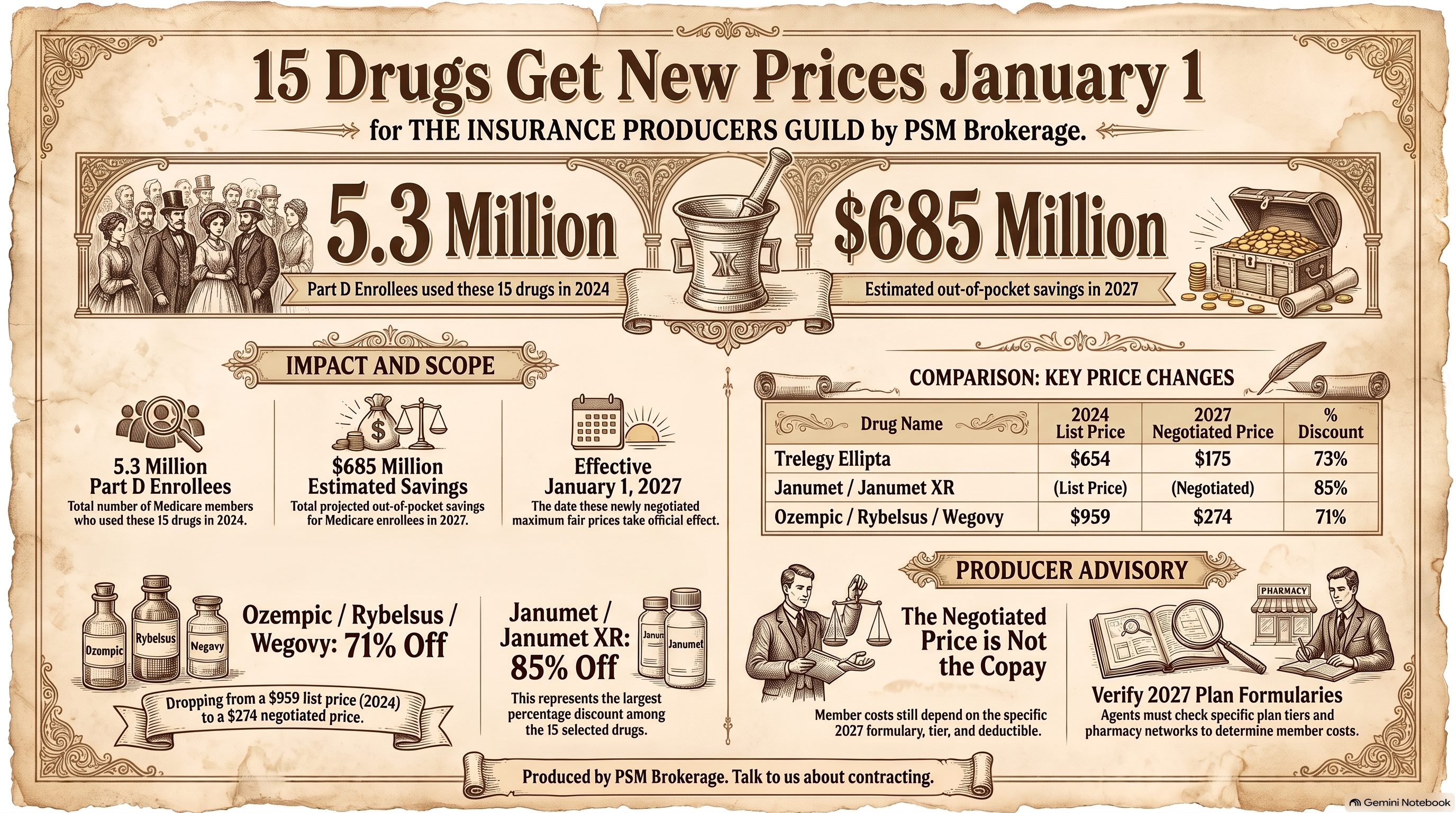
Slides: https://www.psmbrokerage.com/hubfs/The%20Insurance%20Producers%20Guild/IPG_EP26_Slides.pdf
The Insurance Producers Guild Podcast delivers intelligence for insurance agents looking to stay ahead of industry trends.
Follow the show and connect with PSM Brokerage to access tools, training, and support designed to help you grow your business.
Learn more: https://www.psmbrokerage.com
Imagine telling your absolute best client that the government, you know, just slashed the price of their daily medication by 71 percent.
SPEAKER_01Oh man, they would be thrilled. I mean, they are calculating the savings in their head instantly.
SPEAKER_00Aaron Powell Right. And then you have to look them in the eye and explain why their actual pharmacy bill just went up.
SPEAKER_01Yeah, that is rough.
SPEAKER_00Aaron Powell It is the exact nightmare-facing Medicare agents on January 1st. Well, if they do not get ahead of this news cycle right now.
SPEAKER_01It is a massive trap. I mean, clients hear these headlines on the evening news and they uh they just immediately assume their copay is dropping automatically.
SPEAKER_00They think the problem is solved.
SPEAKER_01Exactly. They assume they do not need an annual plan review. And if you assume your client is fine because of these headlines, well, you are gonna lose that client.
SPEAKER_00We are looking at a stack of sources today, including the latest CMS announcements and Medicare utilization data. We are focusing on the 15 part D drugs affected by the new maximum fare prices for 2027.
SPEAKER_01Right. And our mission for this analysis of the sources is to really break down exactly what you need to understand about these changes.
SPEAKER_00Aaron Powell And the precise words you should use with your clients to maintain control. Plus, you know, the exact actions you must take this week before the annual enrollment period even begins.
SPEAKER_01Because when we look at the data, I mean, client confusion is actually an agent's greatest opportunity to prove their value.
SPEAKER_00Absolutely.
SPEAKER_01I have been through these regulatory cycles before, and the pattern is, well, it is always the same. The agents who panic, they usually lose their book of business.
SPEAKER_00Which makes sense. But the agents who recognize the pattern, they step in.
SPEAKER_01Exactly right. They clarify the reality for the client and they secure the relationship for years to come.
SPEAKER_00So to protect your book today, you first need to know exactly which clients and which prescriptions are in the crosshairs of this change.
SPEAKER_01Right. The Centers for Medicare and Medicaid Services, or CMS, has completed its second cycle of negotiations. We now have 15 Part D drugs with a maximum fair price taking effect on January 1st, 2027.
SPEAKER_00The sheer scale of this in the CMS data is staggering. Yeah. I mean, in 2024 alone, 5.3 million Part G enrollees use these specific medications.
SPEAKER_015.3 million. That is a massive portion of the market.
SPEAKER_00It really is. And if these new negotiated prices had been in effect in 2024, CMS estimates there would have been $12 billion in savings. Those are massive market moving numbers. But we need to look closely at the heavy hitters on this list, because these are household names your clients ask for every single day.
SPEAKER_01Oh, definitely. We are talking about Ozempic, Rebelsis, and Wagovy.
SPEAKER_00According to the data, these are dropping from a $959 list price for 30-day supply down to a $274 negotiated price.
SPEAKER_01Which is a 71% discount.
SPEAKER_00Right. And the list continues with some very common prescriptions that impact millions of seniors. Trelogy Ellipta sees a 73% discount.
SPEAKER_01And Janumet and Janumet XR are seeing an 85% discount.
SPEAKER_0085% is huge. It takes a massive bite out of the original list price. Linsus is at 75%.
SPEAKER_01You also have drugs like Ibrants and Ochev showing a 50% discount. I mean, we are talking about medications that treat type 2 diabetes, obesity with cardiovascular disease, asthma.
SPEAKER_00COPD, prostate cancer, multiple myeloma.
SPEAKER_01Right. Idiopathic pulmonary fibrosis and plaxoriasis. It fundamentally becomes a list problem for the agent. You need to pull your client database immediately and search for these specific drug names.
SPEAKER_00Aaron Powell But wait, let me stop you there and ask about one specific number from the Medicare data that is uh well, it is confusing a lot of agents in the field.
SPEAKER_01Okay, sure.
SPEAKER_00CMS projects $685 million in out-of-pocket savings for members in 2027.
SPEAKER_01Aaron Powell Yeah, that is the number everyone is talking about.
SPEAKER_00Aaron Powell Because when an agent hears $685 million, the immediate assumption is that every single client taking Ozepic is going to see a huge windfall at the pharmacy counter.
SPEAKER_01Right.
SPEAKER_00How do you reconcile that massive number with the reality on the ground?
SPEAKER_01Aaron Powell That is exactly where the confusion starts. While the aggregate savings of $685 million are huge, they are spread out across millions of people.
SPEAKER_00So it's not an equal distribution at all.
SPEAKER_01Absolutely not. A fraction of those $5.3 million enrollees will see significant savings. Others might see their out-of-pocket costs remain exactly the same.
SPEAKER_00And some could see their costs go up.
SPEAKER_01Paradoxically, yes. That makes individual plan reviews absolutely critical. You cannot treat your entire book of business the same way this year. Aaron Powell Okay.
SPEAKER_00I want to dig into that paradox you just mentioned. Yeah. Because that is the part that sounds completely backwards. You pull your list and you find 50 clients on Ozempic and 30 clients on Trilogy.
SPEAKER_01Right. So you have a targeted group.
SPEAKER_00Aaron Powell But what does that 71% discount actually mean for the person standing at the pharmacy counter in January? Because if the government is forcing an 85% discount on a drug like Janumed, how on earth does the client not see that directly in their copay?
SPEAKER_01This is the most important distinction we can make today. It requires looking at how insurance carriers actually operate behind the scenes.
SPEAKER_00Okay, break that down for us.
SPEAKER_01The maximum fair price that CMS negotiated is strictly a plan to manufacturer price. It is the cost the insurance plan pays, not the cost the member pays.
SPEAKER_00Oh wow. So do not ever quote that $274 negotiated price as the client's new cost.
SPEAKER_01Never. Promising that number is a dangerous mistake that will instantly ruin your credibility when January rolls around.
SPEAKER_00So if I am hearing you right, this is basically like a grocery store getting a massive wholesale discount on apples directly from a farmer.
SPEAKER_01That is a perfect way to visualize it.
SPEAKER_00Just because the grocery store saved a ton of money on the back end does not mean I get cheaper apples at the register. The store might just hide those apples on the bottom shelf, you know.
SPEAKER_01Or they might make you buy a special store membership before you can access the discount.
SPEAKER_00Exactly. The underlying cost for the business changed, but retail pricing still requires navigating the store's rules.
SPEAKER_01Yeah. The discount happens entirely behind the scenes between the manufacturer and the insurance plan. The mechanics of Part D dictate the reality for the consumer, and we have to understand the profit motives at play here.
SPEAKER_00Aaron Powell Right. Because historically, insurance carriers rely heavily on manufacturer rebates to keep their plan premiums low.
SPEAKER_01Aaron Powell Exactly. And when the government steps in and sets a maximum fare price, those behind-the-scenes manufacturer rebates often disappear.
SPEAKER_00Ah, so the carrier is suddenly losing a massive revenue stream that they use to offset costs.
SPEAKER_01Precisely. They are not acting maliciously. They just have to manage their risk and balance their books.
SPEAKER_00Aaron Powell So when those rebates vanish, the carrier has to compensate.
SPEAKER_01Right. So they pull the levers they still control, which is the formulary structure. A drug can have a significantly lower negotiated price, but the insurance plan might still place it on a worse tier.
SPEAKER_00Because the tier, the deductible phase, and the pharmacy network still dictate the final out-of-pocket cost.
SPEAKER_01Exactly. To offset their loss rebates, the plan might move a highly utilized drug from a preferred tier three down to a non-preferred tier four.
SPEAKER_00And we know exactly what happens when a drug moves to a higher tier. The client stops paying a flat $47 copay, and suddenly they're paying a percentage of the total cost, like 30 or 40% coinsurance.
SPEAKER_01Yep. That is how a price cut on the news turns into a massive bill at the pharmacy.
SPEAKER_00It is wild.
SPEAKER_01And tier changes are just one tool the carriers have. They might introduce new hurdles to control utilization.
SPEAKER_00Like what?
SPEAKER_01Well, they could require a strict new prior authorization before they even agree to cover the medication in 2027.
SPEAKER_00Oh. Or they could implement step therapy. Trevor Burrus, Jr.
SPEAKER_01Right. Requiring the client to try a cheaper, alternative generic medication first and prove that it fails before they will approve the newly negotiated drug.
SPEAKER_00Aaron Powell Which is incredibly frustrating for a client who's been stable on trilogy for three years. The last thing they want to hear is that they have to switch to a different inhaler just to appease the insurance company.
SPEAKER_01Exactly. Trevor Burrus, Jr.
SPEAKER_00What about the pharmacies themselves? Does this change where clients can actually go to pick up their prescriptions?
SPEAKER_01It absolutely can. The carriers can also move the medication away from a preferred pharmacy network.
SPEAKER_00So your client might have gone to the exact same neighborhood pharmacy for 10 years.
SPEAKER_01Right. But if that specific pharmacy is no longer preferred for that specific medication under the 2027 plan contract, their out-of-pocket costs will spike.
SPEAKER_00Regardless of the maximum fair price negotiated by the government. Yes.
SPEAKER_01The client still has to navigate the complex formulary structure to see any of those benefits.
SPEAKER_00This is exactly why I always say client confusion is your greatest opportunity as an agent. If the government just magically lowered the copay at the register, they would not need you.
SPEAKER_01Exactly. But because the insurance carriers have all these levers to pull, like tiers, prior authorizations, and preferred networks, the client desperately needs an expert to interpret the 2027 formulary for them.
SPEAKER_00It is an opportunity to be the hero.
SPEAKER_01It really is. The agents who see this as a problem are going to struggle. The agents who see this as an opportunity to demonstrate their expertise are going to grow their books significantly.
SPEAKER_00So now that we understand the mechanics behind the pricing and why the carriers are going to shuffle the deck, it is time to monetize this knowledge. We need a concrete action plan to secure your client base before AEP starts.
SPEAKER_01Action is what separates the top producers from the rest of the pack in this industry. You have to be proactive.
SPEAKER_00If you wait for the client to call you with a question about a news article they read, they are already confused.
SPEAKER_01Right. Their guard is up, and they are highly vulnerable to another agent who is cold calling them with promises of lower drug costs.
SPEAKER_00Here is the exact action plan you need to execute. Go into your CRM and tag every Medicare Advantage prescription drug plan, meaning your MAPD clients and your standalone PDP clients who take any of these 15 drugs.
SPEAKER_01And you need to complete this tagging process by the end of this week.
SPEAKER_00Once you have your list, you need a precise way to communicate the reality to them without causing a panic. As a closer, I rely on scripts that control the narrative. I'm going to give you the exact word-for-word field script to use when you call them. Write this down.
SPEAKER_01This is the gold right here.
SPEAKER_00Okay, here it is. Medicare publishes a new price on 15 drugs starting January 1st. That does not automatically change what you pay at the counter. I need your drug list. When the 2027 formulary is up, we will check tier and pharmacy before you enroll.
SPEAKER_01I love that script.
SPEAKER_00Let me break down why it works. It does not overexplain, it acknowledges the news they might have heard, but it immediately anchors them to the reality that they still need you.
SPEAKER_01Right, because it eliminates client anxiety by giving them a simple task. A beginner agent usually makes the mistake of over-explaining the government negotiation process.
SPEAKER_00Oh, yeah. They start quoting the 71% discount or explaining the intricacies of the statute.
SPEAKER_01We're talking about manufacturer rebates. That just confuses the client and makes them think they are guaranteed a massive savings, but your script keeps the client focused on cooperation.
SPEAKER_00Exactly. It establishes you as the authority who is monitoring the situation for them. It pushes toward the close by giving them a clear, simple directive. I need your drug list.
SPEAKER_01Setting the expectation that we are going to do a full, comprehensive review before they enroll in anything.
SPEAKER_00And for those of you who partnered with us, utilizing PSM brokerage capabilities gives you a massive advantage in executing this strategy. We have verified services built specifically for this exact scenario.
SPEAKER_01Yes, the tools are ready.
SPEAKER_00You can go direct to the marketing hub right now and download a professionally designed, co-branded drug review letter. You can mail this directly to the clients you just tagged in your system.
SPEAKER_01Having professional collateral is crucial for building trust, but you also need to make sure your messaging is entirely compliant.
SPEAKER_00Right.
SPEAKER_01That is where you utilize the compliance and legal department. They can clear this marketing material to ensure you stay compliant with all CMS regulations.
SPEAKER_00You never want to risk a compliance infraction or a warning just because you phrased a letter incorrectly or used the wrong disclaimer.
SPEAKER_01Exactly. Let the experts clear it for you so you can focus on selling.
SPEAKER_00Absolutely. And once you start getting those drug lists back from your clients, you're going to find that a significant portion of them need to move to an entirely different carrier to get the best tiering and pharmacy network for these 15 drugs.
SPEAKER_01Which is why you need to utilize contracting support today.
SPEAKER_00Do not wait until October. Get any necessary 2027 appointments lined up right now.
SPEAKER_01You want those carrier contracts active and ready so that when you find a better plan for your client, you can write the business immediately.
SPEAKER_00Because historical patterns show us that agents who delay their contracting often lose the sale.
SPEAKER_01I have seen it happen a hundred times. The agent does the hard work, they review the formulary, they find the perfect plan that covers Ozempic on a preferred tier, and then they realize they are not appointed with that specific carrier.
SPEAKER_00Oh, that is the worst.
SPEAKER_01By the time they submit the paperwork and get the appointment finalized, a week has passed and the client has already spoken to someone else. Getting your contracting straight today is a vital defensive maneuver for your book of business.
SPEAKER_00Let us expand on the other drugs on this list because we have focused heavily on Ozempic, Janumet, and Trelogy. You also need to be tagging clients taking Extandi, Pomelist, Calquins, Ostado, Braellipta, Trigenta, Cfaxin, Vrailar, and OTesla.
SPEAKER_01These are highly specialized medications.
SPEAKER_00Right. Clients taking these drugs are often dealing with very serious life-altering conditions like prostate cancer or multiple myeloma. They are already under an immense amount of stress.
SPEAKER_01Huge amounts of stress.
SPEAKER_00When they hear the government is negotiating drug crises, their first thought is not about saving 20 bucks. Their first thought is absolute terror that their life-saving medication will become unavailable or that their coverage rules will change.
SPEAKER_01That is a critical point that agents often miss. The emotional state of your client matters immensely. When you are dealing with oncology drugs or specialized therapies, the cost is secondary to access.
SPEAKER_00So when you reach out using your script, you are not just asking for a list to save them money.
SPEAKER_01You are providing profound reassurance. You are telling them that you are ahead of the news cycle. You are confirming that their continued access to these critical medications is your top priority.
SPEAKER_00You are taking the heavy burden of navigating the confusing 2027 landscape off their shoulders and putting it squarely onto yours.
SPEAKER_01And that builds a level of loyalty that no competitor can break.
SPEAKER_00I always tell my agents that confidence is contagious. When you call them and state the facts clearly without any hesitation, they trust you implicitly. Just read the script. Exactly. Medicare published a new price on 15 drugs starting January 1st. That does not automatically change what you pay at the counter. I need your drug list. When the 2027 formulary is up, we will check tier and pharmacy before you enroll. You deliver that with authority, and they will follow your lead every single time.
SPEAKER_01We should also touch on the timeline and scope of what we are dealing with here. CMS recently announced a third negotiation cycle for prices effective in 2028, but we are actively ignoring that for now.
SPEAKER_00Right, because we are strictly managing the January 1st, 2027 price changes that are already agreed upon and published in the source data.
SPEAKER_01The landscape for 2027 is the only thing that matters right now. You must pull the 2027 formulary when it becomes public and compare the exact same drug across all available plans in your client-specific zip code.
SPEAKER_00That means you cannot rely on last year's data or your past experience with a carrier.
SPEAKER_01Never assume.
SPEAKER_00Because carrier A might have covered Janumet beautifully in 2026. They might have had it on a preferred tier with a low copay. But in 2027, because they lost those manufacture rebates we talked about, they might shift it to a non-preferred tier.
SPEAKER_01Despite the 85% maximum fair price discount.
SPEAKER_00Exactly. Meanwhile, carrier B, who maybe had terrible coverage last year, might strategically place it on a preferred tier with a low flat copay to capture market share.
SPEAKER_01You have to run the models for every single client on these 15 drugs. There are zero shortcuts this year.
SPEAKER_00The complete lack of shortcuts is exactly why the professional agent will thrive in this environment. The complexity filters out the order takers.
SPEAKER_01An agent who just rolls their clients over from year to year, assuming everything will be fine, is going to get totally exposed in 2027.
SPEAKER_00When their client goes to the pharmacy in January and gets hit with a massive bill because their preserved pharmacy was dropped from the network, well, that client is going to find a new agent immediately.
SPEAKER_01That is the harsh reality of this business. You either secure the client through hard work, clear communication, and comprehensive plan reviews, or you lose them to someone who is willing to put in the effort.
SPEAKER_00The tools are all there for you to succeed. The marketing hub has the letters ready to go. The compliance and legal department will review your materials to keep you safe from CMS scrutiny. Contracting support will give you the appointments you need to write the business across multiple carriers. All that is left is the execution.
SPEAKER_01It all comes back to properly managing expectations. Do not ever promise savings based on a news headline. Promise a comprehensive review.
SPEAKER_00You are promising to find the best possible outcome based on the realities of the actual 2027 formulary.
SPEAKER_01If you do that, you solidify your role as an indispensable advisor rather than just a salesperson. You become a partner in their healthcare journey.
SPEAKER_00I want to leave you with a final scenario to consider before we wrap up today. Think about your top client, the one who sends you three referrals a year, the one who trusts you completely, the anchor of your book of business.
SPEAKER_01We all have one.
SPEAKER_00What happens if a competing agent who is hungry for new business calls that top client with this exact script before you do?
SPEAKER_01Oh man, the information is entirely public. The news is out there on every major network.
SPEAKER_00Every agent in the country has access to the list of these 15 drugs. But the agent who acts on it first, the one who calls and says, I am reviewing your medications to protect your access and your wallet, that is the agent who wins the trust.
SPEAKER_01Do not let someone else secure your best client just because you waited too long to pick up the phone.
SPEAKER_00That's this episode of the Insurance Producers Guild. Stay tuned for the next one. If you're not already with PSM Brokerage, this is the intelligence our agents get. Talk to us about contracting.