
The Insurance Producers Guild
The Insurance Producers Guild is a strategic briefing for insurance professionals, focused on Medicare, ACA, life insurance, and the evolving insurance landscape. Each episode distills complex industry changes into clear, practical intelligence.
AI was used in the making of these podcasts.
The Insurance Producers Guild
EP27 SEO Lost Shelf Space. AI Is the New Front Door
Use Left/Right to seek, Home/End to jump to start or end. Hold shift to jump forward or backward.
Google's organic shelf is concentrating. In Kevin Indig's Growth Memo index (GIB #25, Oct 2, 2026), total visibility rose 1.8% over 12 months while the median company lost 17.2%. Own-domain sites fell 18.5%. Platforms like YouTube and Facebook gained. Zero-click searches hit 68.01% of US Google searches in early 2026 (SparkToro/Similarweb), so roughly 2 in 3 searches end without a visit.
Click reports also undercount AI discovery. Growth Memo (Sep 28, 2026) shows the path is prompt, synthesize, direct visit, and Graphite finds last-touch can miss about 10x of that influence. Amanda Natividad of SparkToro says plan for mentions, citations, and community presence before the click.
This episode covers why a traffic drop is not a lost book, the "How did you find me?" CRM ask, three Monday fixes, and a simple 2027 plan.
🔑 Key Topics Covered
- SEO shelf concentration and platform winners
- Zero-click search and AI underattribution
- Citations before the visit: mentions, communities, third-party signals
- Three-layer scoreboard: exposure, discovery, appointments
🎯 What This Means for Agents
- Do not panic-rebuild a website when sessions are down about 15 to 20%
- Ask every new appointment how they found you and tag it in the CRM
- Fix Google reviews, named bio, and a date-stamped service page first
- Show up surface by surface. AI citations rarely overlap across engines
🔗 Sources
Growth Memo by Kevin Indig: The usefulness of attribution for AI Search
https://www.growth-memo.com/p/the-collapse-of-attribution
Growth Memo by Kevin Indig: Growth Intelligence Brief #25
https://www.growth-memo.com/p/growth-intelligence-brief-25
Growth Memo by Kevin Indig: 2027 planning brief featuring Amanda Natividad, https://www.growth-memo.com/p/how-to-plan-2027-when-traffic-is
📌 GO-DO: Ask, Fix, Scoreboard
Ask every new appointment: "How did you find me?" Options at minimum: Google, referral/friend, ChatGPT or other AI, Facebook or social, review site, other. Enter it the same day.
Three fixes this week: Google Business Profile under 50 reviews or newest older than 60 days, text three happy clients the review link. About/bio has your real name, real photo, and LinkedIn. Main Medicare or Final Expense page gets a visible "Updated [month year]" and one honest paragraph refresh.
Monthly 3-number scoreboard: (1) exposure, new reviews or named mentions, (2) CRM discovery tags, (3) booked appointments. If exposure is up but discovery is flat, you are showing up in the wrong places. If discovery is up but appointments are flat, fix the page or the offer. If both are down, audit who AI and review sites recommend in your market.
For 2027, keep proven work, run one capped test with a kill date, and fund some unmeasurable bets without demanding a clean click report. If you need co-branded review-request or bio templates, use PSM Marketing Hub and send wording through the Compliance and Legal Department.
Infographic: https://www.psmbrokerage.com/hubfs/The%20Insurance%20Producers%20Guild/IPG_EP27_Infographic.png
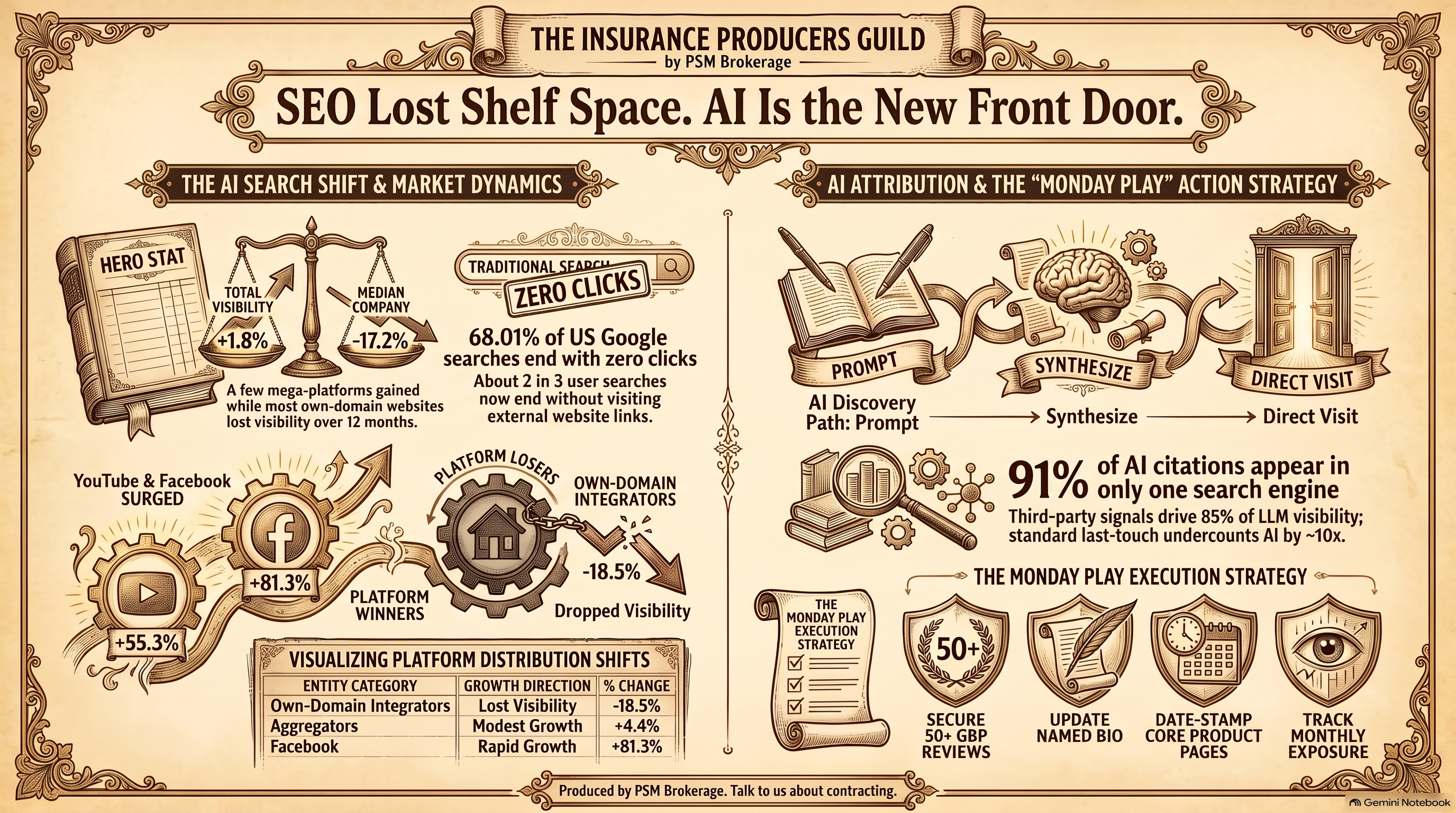
Slides: https://www.psmbrokerage.com/hubfs/The%20Insurance%20Producers%20Guild/IPG_EP27_Slides.pdf
The Insurance Producers Guild Podcast delivers intelligence for insurance agents looking to stay ahead of industry trends.
Follow the show and connect with PSM Brokerage to access tools, training, and support designed to help you grow your business.
Learn more: https://www.psmbrokerage.com
So picture this. You log into your Google Analytics dashboard on a Tuesday morning, you pull up the monthly report, and uh you see this massive, undeniable drop in website traffic.
SPEAKER_00Aaron Powell Oh, yeah. The absolute worst feeling.
SPEAKER_02Right. Your agency blog, the one you've poured just, you know, hours into writing, it feels completely dead. All the lines on the graph are pointing down.
SPEAKER_00Aaron Powell Yeah. And immediately that familiar knot just forms right in your stomach.
SPEAKER_02Aaron Powell Exactly. You assume your leads are drying up. You think, well, the phone is going to stop ringing, and my whole book of business is about to take a massive hit.
SPEAKER_00Aaron Powell It is a terrifying moment, I mean, for any independent agent. You sit there staring at those downward red arrows, thinking, uh, I must be doing something fundamentally wrong here.
SPEAKER_01Right.
SPEAKER_00You start wondering, you know, do I need to buy a whole new lead list? Do I have to completely overhaul my entire business model?
SPEAKER_02Aaron Powell Listen, I've been through three major shifts in this industry, and I recognize that exact panic. I remember when the physical yellow pages finally died.
SPEAKER_00Oh wow. Yeah. That was brutal.
SPEAKER_02Guys who had built their entire careers on a full page ad and they suddenly found the phone was completely silent and they just panicked. But let's uh let's unpack this and dissolve that fear right out of the gate for you today.
SPEAKER_00Please.
SPEAKER_02A traffic drop to your homepage is not automatically a lost book of business. We're looking at a stack of recent growth intelligence memos, and the data tells a completely different story. Early this year, 68.01% of US Google searches ended with zero clicks.
SPEAKER_00Wait. Zero.
SPEAKER_02Zero. Let me repeat that. 68%. That is hard data from SparkToro and similar web.
SPEAKER_00That is so roughly two out of every three searches happening right now end without a single website visit.
SPEAKER_02Exactly. Which begs the question. You know, if people are searching for Medicare or final expense policies, but two-thirds of them aren't even clicking on a website, how are they actually buying anything?
SPEAKER_00Aaron Powell That is the million-dollar question.
SPEAKER_02Right. So the mission for this deep dive is to map out exactly what is happening to the digital shelf. The shelf where your clients find you, it hasn't disappeared. It just moved. It moved to platforms and AI answers. Aaron Powell Yeah.
SPEAKER_00And AI is actively hiding the path, basically.
SPEAKER_02Aaron Powell Exactly. Your future clients are seeing you in a you know a summarized AI answer, or maybe they spot someone mentioning your name in a local Facebook community group and then they bypass the search engine entirely.
SPEAKER_00Right. They just pick up the phone and call you. Or they type your agency's name directly into their browser.
SPEAKER_02Aaron Powell Which means your traditional tracking software completely misses the handoff. You're measuring the wrong things.
SPEAKER_00Aaron Powell You are. I want to dig into that actually, because if two-thirds of searches don't result in a click, we need a map of where this new digital shelf actually lives.
SPEAKER_02Aaron Powell Let's do it.
SPEAKER_00Okay. So let's look at the 12 months leading up to September 14, 2026. Total search visibility overall grew by 1.8%. But the median company actually lost 17.2% of its visibility.
SPEAKER_02Wait, that that feels like a total contradiction. How does the total go up, but the average company tanks?
SPEAKER_00Aaron Powell I know it sounds like one, but it points to this massive wealth transfer of attention. A few giants basically gained all the points, and everyone else lost a huge share of what they had.
SPEAKER_02Oh, I see.
SPEAKER_00Yeah. The split between company types is the biggest headline here for independent producers. It really comes down to integrators versus aggregators.
SPEAKER_02Aaron Powell Let's uh let's define those for a second just so everyone's on the same page.
SPEAKER_00Aaron Powell Sure. So an integrator is a company that makes what it sells and publishes on its own domain. Think of your standard independent insurance agency website. You write a blog post, you host it on your site.
SPEAKER_02Aaron Powell Right. Your own turf.
SPEAKER_00Exactly. Over that 12-month window, integrators lost 18.5% of their visibility. They just fell off a cliff.
SPEAKER_01Wow.
SPEAKER_00Meanwhile, aggregators, like the massive platforms where millions of users post their own content, they gained 4.4%.
SPEAKER_02Aaron Powell So all the growth went to the big platforms. The specific winners taking up all that shelf space are pretty staggering. I mean, YouTube gained 55.3% and Facebook gained 81.3%.
SPEAKER_00It's insane.
SPEAKER_02It is. So the growth and search visibility went entirely to platforms where real people just, you know, interact and post.
SPEAKER_00Aaron Powell Yeah. So if you're an agent spending like four hours a week writing generic content that lives only on your own domain, you are bleeding shelf space to those platforms. Aaron Powell Yeah.
SPEAKER_02Orbit Media surveyed over a thousand content marketers recently, and only 14% reported strong results from blogging.
SPEAKER_00Aaron Powell Just 14?
SPEAKER_0214%. That is a 12-year low. But let me make sure I understand the mechanism here because I think a lot of agents might get confused. Are you saying I should just like abandon my agency website entirely and spend all day posting on a Facebook business page?
SPEAKER_00Aaron Powell No, no. Let's not swing the pendulum completely in the other direction. We need to introduce a crucial layer of nuance here regarding how AI actually operates. Aaron Powell Winning classic Google shelf space on these aggregator domains is not the same as winning AI citations.
SPEAKER_02Aaron Powell Walk me through the difference there.
SPEAKER_00Aaron Powell Okay. Think about how a large language model or LLM actually works. This is the engine behind tools like ChatGPT or Perplexity. An LLM is essentially a super reader that has ingested millions of websites. Right. But it doesn't just blindly trust the loudest voice or the biggest directory. It actively looks for a consensus across different sources. The data shows aggregators hold about 76% of the SEO visibility split.
SPEAKER_02Aaron Powell Meaning if you search Google normally, you see Yelp or Facebook right at the top.
SPEAKER_00Trevor Burrus Exactly. Right. But those same aggregators only hold about 38.3% of Chat GPT's citation pool.
SPEAKER_02Aaron Ross Powell Ah, okay. I see. Let me let me try an analogy here because I love patterns. Traditional Google search is sort of like walking into a massive library. You look at the directory, you find the section, and you pick the book yourself.
SPEAKER_00Right.
SPEAKER_02And aggregators are just the biggest bookshelves in that library. But AI search is entirely different. It's like walking in and asking a master librarian a question.
SPEAKER_00Aaron Ross Powell Oh, that is a brilliant way to frame it.
SPEAKER_02Aaron Powell Yeah. And the librarian doesn't just hand you the biggest book. They synthesize an answer based on what a dozen different authors have recommended.
SPEAKER_00Exactly.
SPEAKER_02So if you only focus on getting a profile on a big aggregator site, you might win the traditional bookshelf, but the AI librarian still won't cite you because you don't have consensus across the wider web.
SPEAKER_00Aaron Powell Right. The librarian wants to see your name mentioned in local news, in Reddit discussions, in customer reviews, you know, community forums. Winning a review site shelf requires entirely different tactics than being explicitly named as a recommended agent in an AI synthesized answer.
SPEAKER_02Aaron Powell Wait, so if the dashboard says my traffic is down and I'm essentially relying on this invisible librarian to recommend me, I mean I feel like I'm flying completely blind here.
SPEAKER_00Oh, totally.
SPEAKER_02If I can't track clicks from search engines anymore, how on earth am I supposed to know if my marketing is actually working?
SPEAKER_00Aaron Powell Welcome to the attribution collapse.
SPEAKER_02The attribution collapse.
SPEAKER_00Yeah, your traditional tracking software is actively lying to you about how clients are finding you right now.
SPEAKER_02Aaron Powell Okay, explain that.
SPEAKER_00Well, the old model we all grew up with was highly visible, right? It was search, click, convert. A senior types Medicare agent near me into Google, clicks the link with all the tracking tags attached, lands on your site, fills out a form.
SPEAKER_02Yeah, and you can see that entire journey clearly in Google Analytics.
SPEAKER_00It paints a totally clean line from A to B. But the new model is entirely invisible. It goes prompt, synthesize, direct visit.
SPEAKER_02Prompt, synthesize, direct visit.
SPEAKER_00Yeah.
SPEAKER_02Okay.
SPEAKER_00Yeah. The client asks an AI a question on their phone app. The AI synthesizes an answer that happens to mention your specific agency. The client reads it, closes the app, opens their web browser, and types your agency's domain directly into the address bar.
SPEAKER_02And because they typed it directly, my analytics dashboard just registers that as direct traffic, completely stripping away the fact that ChatGPT sent them in the first place.
SPEAKER_00Exactly. The software has absolutely no idea the AI was involved because no referring link was ever clicked. The graphite research cited in these intelligence memos shows that last touch click tracking undercounts AI discovery by about 10x. 10 times.
SPEAKER_02Oh, interesting. What happened to their traffic? I would assume search traffic skyrocketed.
SPEAKER_00Aaron Powell Actually, it's the exact opposite.
SPEAKER_02Huh?
SPEAKER_00Direct visits to the brand rose. They saw a 14.2% lift in people typing in Capital One directly.
SPEAKER_02Wow.
SPEAKER_00But search visits ran about 15% lower.
SPEAKER_02Wait, really?
SPEAKER_00Yeah. People weren't searching for them on Google anywhere to find the link. The AI already told them who to go to. So they just completely bypassed the search engine.
SPEAKER_02That makes total sense.
SPEAKER_00Right. So when you look at your dashboard and see a spike in direct traffic, it often just means AI influence. Your dashboard reads it as unknown noise, but it's actually AI driving the demand.
SPEAKER_02Aaron Powell There's a quote in the memos from Amanda Natividad, the VP of marketing at SparkToro that I think perfectly crystallizes the strategy we need to adopt here.
SPEAKER_00Oh, I love this quote.
SPEAKER_02Aaron Powell She says if people are increasingly getting answers without clicking, then you need to plan for the signals that happen before or instead of the visit. That means prioritizing things like brand mentions, citations, discussions about your brand, and participation in the communities where your audience already hangs out.
SPEAKER_00Yes. Influence lands before the website visit now. A senior looking for a final expense policy might read an AI answer, you know, scan a Reddit thread, and see a peers post in the Facebook group recommending you before they ever visit your website once.
SPEAKER_02But you can't just expect to magically appear in all these places either. The data shows that 91% of citations appear in only one AI engine.
SPEAKER_00Well, just one.
SPEAKER_02Yeah, whether that's Chat GPT, Perplexity, or Google's AI overviews. Plus, AirOps found that third-party signals, what other people say about you, drive 85% of large language model brand visibility.
SPEAKER_00Aaron Powell Okay. So here is the immediate burning challenge for the agent sitting at their desk right now. Because digital tracking is completely broken, you need a way to monetize this and track it today.
SPEAKER_02Right. You can't wait two years for the software companies to invent a solution.
SPEAKER_00Exactly. We need a manual override. We're going to implement a triangulation technique to track reality straight from the source.
SPEAKER_02Okay, what do I do?
SPEAKER_00I want you to use this exact word-for-word script on every single new appointment. And you have to write the answer in your CRM that exact same day. Do not skip this.
SPEAKER_02Okay, what's the script?
SPEAKER_00Here it is. Quick question before we start. How did you find me? Google, a friend, Chat GPT, Facebook, a review site, or something else?
SPEAKER_02Aaron Powell Okay, let me ask you this. Why do I need to list out all those options? Like why not just ask, hey, how did you hear about me and let them answer organically?
SPEAKER_00Aaron Powell Because if you leave it open-ended, the client will almost always just say, Oh, I found you on the internet.
SPEAKER_02Uh true.
SPEAKER_00And that tells you absolutely nothing. By giving them the menu, you jog their memory. When you explicitly mention ChatGPT or Facebook, they will pause and say, actually, yeah. I asked ChatGPT for a local Medicare agent who specializes in diabetes and it gave me your name.
SPEAKER_02Aaron Powell So by capturing that reality manually in my CRM, I am building my own attribution dashboard.
SPEAKER_00Exactly. I can look back at the end of the month and see that while Google Analytics claims my traffic is dead, my CRM shows ChatGPT drove five closed deals. You build a triangulation layer that you can run this week without needing a data science degree.
SPEAKER_02I love that. Okay, so let's step into the shoes of a hypothetical agent. Let's call him Bob.
SPEAKER_00Okay, Bob.
SPEAKER_02Bob runs a Medicare agency in Ohio. Bob realizes his digital scoreboard is broken. He starts using your CRM script and he starts tracking reality. But how does Bob actually fix his off-site presence? Like how does he make sure the AI librarian is picking his book to recommend?
SPEAKER_00Well, Bob needs to replace his broken digital dashboard with a new manual scoreboard for 2027. And we break this into three distinct layers.
SPEAKER_02Okay. What's layer one?
SPEAKER_00Layer one is exposure. This basically tracks your reviews across platforms and any mentions of your agency across the web.
SPEAKER_02Makes sense.
SPEAKER_00Layer two is behavior. This looks at your branded direct website visits combined with those CRM how did you find me tags we just talked about.
SPEAKER_02Okay, and layer three? Okay, so if I am Bob and I am reporting those three layers monthly, how do I read the tea leaves? Let's say my exposure is way up. I'm getting mentions in local groups, I'm getting reviews, but my discovery and behavior metrics are totally flat. Nobody is calling and direct traffic is stagnant.
SPEAKER_00That tells you immediately that you are in the wrong places. Your mentions aren't landing with the right audience.
SPEAKER_02So it's a distribution problem.
SPEAKER_00Yeah, exactly. You might be getting mentioned in a forum that your target demographic never even visits.
SPEAKER_02Okay, let's flip it around. Let's say discovery is up. People are actively searching for my brand, direct traffic has spiked, and the CRM tags show AI is recommending me. But my appointments are flat. I'm not closing anything. Does that mean the AI is giving them bad information about me?
SPEAKER_00No, no. It points to a problem inside your own house. That is a conversion problem. You probably have a bad landing page, a weak offer, or a broken handoff. The AI librarian sent them to your doorstep, but when they got there, you know, the porch was a mess and the door was locked.
SPEAKER_02Oh, that's a great way to picture it. What's the worst case scenario? What if both are down? Exposure is dead, branded search is dead.
SPEAKER_00That means a competitor in your local market is stealing your mentions. You need to immediately audit who the AI is recommending in your specific category and zip code because they are actively eating your lunch.
SPEAKER_02That is a wake-up call. Which brings us to the execution phase. To make sure you're on the winning side of that scoreboard, we have a Monday three fix play. These are three tactical things you can do this week to show up in AI answers and platform shelves.
SPEAKER_00Yes. Fix number one is a brutal reality check. You have to audit your Google business profile. The AI needs to verify that your business is currently alive and active.
SPEAKER_01Right.
SPEAKER_00If you have under 50 reviews, or if your newest review is older than 60 days, comparison pages will beat you every single time.
SPEAKER_02Because AI looks closely at review velocity, right?
SPEAKER_00Exactly. If your last review was from 2024, the AI assumes you might have retired or just gone out of business.
SPEAKER_02You know, the independent producer actually has a massive advantage over the huge national call centers here. You are literally sitting at the kitchen table, you just saved your client $2,000 a year on her Medicare plan. You need to close the feedback loop immediately.
SPEAKER_00Yes.
SPEAKER_02Don't wait. Tell them right then and there that your business relies on word of mouth, text them the link to leave a Google review, and don't let them leave the office until they do it.
SPEAKER_00Keep that review pipeline flowing constantly. The velocity matters way more than having one huge spike three years ago.
SPEAKER_02Okay, what's fix number two?
SPEAKER_00Fix number two, overhaul your about page.
SPEAKER_01Really?
SPEAKER_00Yes.
SPEAKER_01The about page.
SPEAKER_00Yes. The AI engines are scanning the web, trying to verify entity authority. They basically want to know you are a real, credible human being, not just some offshore lead generation fart. You need a real detailed biography, a professional photo, and a direct link to your active LinkedIn profile.
SPEAKER_02So stop hiding behind generic corporate jargon. Exactly. You cannot just put, we provide excellent service on your about page and call it a day. You are the product. The AI needs to connect your actual name to your expertise.
SPEAKER_00Spot on. And fix number three is something I see agents miss constantly. And honestly, it is the easiest one to solve. Date stamp your pages.
SPEAKER_02Date stamp.
SPEAKER_00Yep. Refresh and visibly date stamp your main Medicare or final expense landing pages.
SPEAKER_02Why does a date stamp matter so much to a machine?
SPEAKER_00Aaron Powell Because LLMs are fundamentally trained to prioritize recency, especially for regulated time-sensitive information like Medicare guidelines or tax laws.
SPEAKER_02Oh, that makes sense.
SPEAKER_00Yeah, if your page explains Medicare Part B premiums, but doesn't have a visible recent date stamp, the AI will not trust that the information is current for this enrollment period. It will literally skip over you and cite a competitor who updated their page yesterday.
SPEAKER_02Wow. And it takes what, five minutes? Go into your site, update a few numbers to reflect the current year's guidelines, and just ensure the last modified date is visible at the very top of the article.
SPEAKER_00That's it.
SPEAKER_02So we have the Monday three fixed play, but looking at the bigger picture, if I am building out my 2027 plan, how do I allocate my time and money given this massive shift in the shelf?
SPEAKER_00Aaron Powell You have to treat 2027 like a planned portfolio with strict kill dates. We divide your efforts into three buckets.
SPEAKER_02Okay.
SPEAKER_00First, fully fund what is proven, the tactics that already earn you those citations. Technical SEO, content refreshes, gathering local reviews, fund those at full capacity. Do not abandon the fundamentals just because the landscape is shifting.
SPEAKER_02Good advice. What goes into the second bucket?
SPEAKER_00Cap your learning work. If you're testing new surfaces, maybe you're experimenting with YouTube shorts or spending time answering questions in a new community forum. Give it one dedicated owner in your agency and attach a strict kill date.
SPEAKER_02So don't just let it run forever.
SPEAKER_00Right. If it is not generating those CRM tags after 90 days, kill it. Do not let it drag on as a zombie project.
SPEAKER_02Aaron Powell And the third bucket? Because this is the one that usually makes the highly analytical folks a little nervous.
SPEAKER_00I know it does. Fund unmeasurable bets based on pure professional judgment.
SPEAKER_02Pure judgment.
SPEAKER_00Yeah. Things like deep community participation, sponsoring local events, and offline relationship building. You know these work because you are a professional agent.
SPEAKER_01Right.
SPEAKER_00The Google Analytics dashboard can't track a handshake at a diner, but that handshake leads to a branded search, which leads to an appointment. So lock your annual total budget and re-split it quarterly against that three-layer scoreboard we talked about.
SPEAKER_02It all comes back to a core realization. The insurance industry isn't shrinking. I mean, there are still roughly 10,000 seniors turning 65 every single day in this country. Huge market. Clients are still desperately looking for guidance on Medicare and final expense. The discovery path is just hidden now. They are asking Chat GPT, they're polling their peers in Facebook groups, and then they are calling you directly. You win this new environment by actively managing your exposure off-site.
SPEAKER_00It forces you to stop relying on a passive dashboard and actually get closer to the client's real journey.
SPEAKER_02Exactly. Which brings us to a final thought I want to leave you with today. This insight comes from George Boadacci at Ramp, and it completely shifts the perspective on this entire data panic. He noted that attribution is a crutch when it replaces critical thinking.
SPEAKER_00Consider the weight of that statement. If you lost access to every single digital analytics dashboard tomorrow, if your screen just went permanently dark, how much better would you understand your client's buying journey just by actually listening to them?
SPEAKER_01It totally strips away the illusion of control and forces you back to the fundamentals of sales.
SPEAKER_00Exactly. Don't let the broken dashboard paralyze your agency. Start tagging your CRM with that triangulation script today. Go update your bio and your date stamps this afternoon, and get back to closing business.
SPEAKER_02Well said. Thanks for joining us on this deep dive. We'll see you next time.