
The Insurance Producers Guild
The Insurance Producers Guild is a strategic briefing for insurance professionals, focused on Medicare, ACA, life insurance, and the evolving insurance landscape. Each episode distills complex industry changes into clear, practical intelligence.
AI was used in the making of these podcasts.
The Insurance Producers Guild
EP29 Your ACA Clients Now Verify Themselves. Here's Your Prep Plan
Use Left/Right to seek, Home/End to jump to start or end. Hold shift to jump forward or backward.
ACA Enrollment Starts Nov 1: New ID Checks, Fewer Agents, and a Link Your Client Has to Click
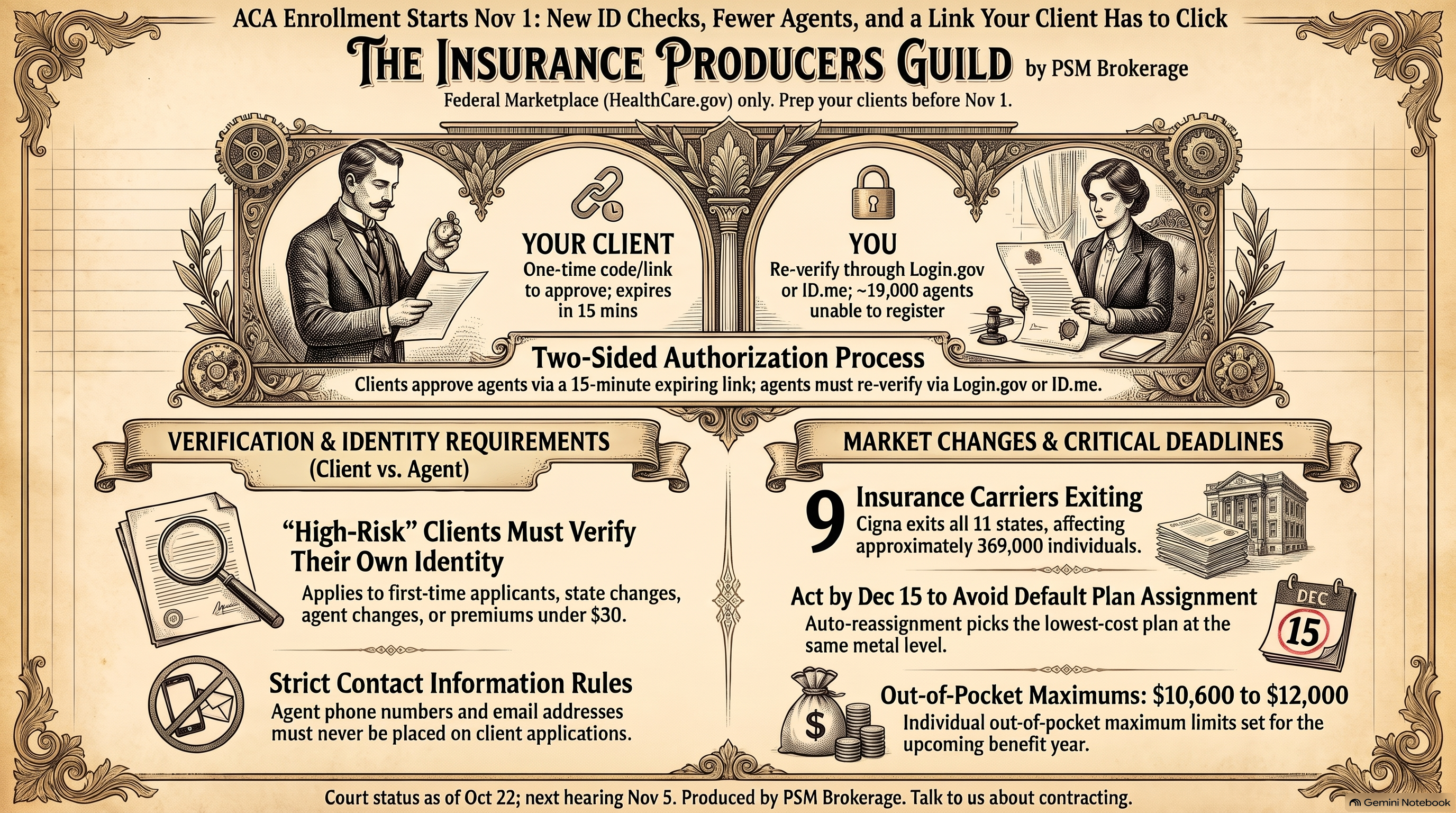
ACA open enrollment starts Nov 1, and federal Marketplace enrollments now have new steps. Every client working with an agent must approve that agent with a one-time code or link, and "high-risk" clients must verify their own identity (KFF Health News).
CMS paused new agent registrations, affecting about 19,000 agents (NABIP), and requires returning agents to re-verify through Login.gov or ID.me (CMS). Cigna is leaving all 11 of its Marketplace states (Insurance Business).
Here's how to prep your book so the first appointment doesn't stall.
🔑 Key Topics Covered
* The new client code or link and "high-risk" identity checks
* Agent re-verification and the registration moratorium
* Carrier exits, auto-reassignment, and the Dec 15 deadline
* 2027 out-of-pocket max and subsidy eligibility changes
🎯 What This Means for Agents
* Finish your Login.gov or ID.me re-verification before Nov 1
* Make sure every client's phone and email is their own, never yours
* Call exiting-carrier clients first and finish before Dec 15
* Document consent separately from authorization
🔗 Sources
CMS: CMS Cracks Down on Fraud, Waste, and Abuse in the Federal Health Insurance Marketplace
https://www.cms.gov/newsroom/press-releases/cms-cracks-down-fraud-waste-abuse-federal-health-insurance-marketplacer
KFF Health News: Shopping for an ACA Plan This Year? Here's What You Need To Know
https://kffhealthnews.org/insurance/aca-obamacare-open-enrollment-marketplace-shopping-tips-premiums-costs-cms-changes/
Insurance Business: ACA carrier exits grow to nine as open enrollment approaches
https://www.insurancebusinessmag.com/us/news/benefits/aca-carrier-exits-grow-to-nine-as-open-enrollment-approaches-591728.aspx
📌 GO-DO: Verify, Confirm, Call
Finish your own Login.gov or ID.me re-verification before Nov 1. Confirm every ACA client's phone and email on file is their own, and tell them the link is coming. Call exiting-carrier clients before Dec 15, and run your consent script through the Compliance and Legal Department. Federal Marketplace only; court status as of Oct 22.
Infographic: https://www.psmbrokerage.com/hubfs/The%20Insurance%20Producers%20Guild/IPG_EP29_Infographic.png
Slides: https://www.psmbrokerage.com/hubfs/The%20Insurance%20Producers%20Guild/IPG_EP29_Slides.pdf
The Insurance Producers Guild Podcast delivers intelligence for insurance agents looking to stay ahead of industry trends.
Follow the show and connect with PSM Brokerage to access tools, training, and support designed to help you grow your business.
Learn more: https://www.psmbrokerage.com
Picture November first. Uh you have your very first ACA appointment of the season sitting right across from your desk. Right. You've done the hard work, right? You found the perfect plan for them. You go to submit the application, and well, everything just stalls out completely.
SPEAKER_00Just a dead stop.
SPEAKER_01Exactly. The system suddenly demands this strict identity check right there at the desk. Or maybe the client's phone number on file is an old landline, so they can't even get the required text messages to approve you.
SPEAKER_00Yeah, that is the operational reality staring us down this open enrollment season. It's rough.
SPEAKER_01It is. And on top of that, very real fear, there are these widespread rumors sweeping the industry right now that thousands of agents cannot even register to sell this season.
SPEAKER_00Aaron Powell Right. Those are the two massive fears dominating pretty much every single agency floor in the country right now.
SPEAKER_01Definitely.
SPEAKER_00I mean the stalls at the desk are incredibly frustrating because they just break your momentum. And the registration rumors are honestly they're terrifying for a lot of professionals who completely rely on this season for their livelihood.
SPEAKER_01Oh, for sure. But we're going to take control of this situation right now.
SPEAKER_00Yes, we are.
SPEAKER_01Because if you are an agent who was registered for 2026 and you prepare correctly right now, these hurdles are really just a speed bump.
SPEAKER_00That's exactly right. Prepared agents will actually acquire more clients this year.
SPEAKER_01Wait, really?
SPEAKER_00Oh, absolutely.
SPEAKER_01More clients.
SPEAKER_00Oh, absolutely. Those consumers desperately need help navigating this new system, you know. And the agents who are ready, they're going to be the ones there to catch them.
SPEAKER_01Okay. I love that. But I do need to state clearly, right out of the gate, that these changes apply strictly to the federal marketplace on healthcare.gov.
SPEAKER_00Aaron Powell Yes. That is such a vital distinction to make early on.
SPEAKER_01Aaron Powell It really is. State-based exchanges have their own platforms, uh their own distinct rules. So if you operate entirely off the federal exchange, your environment looks a bit different.
SPEAKER_00Aaron Powell Right. But on the federal side, I mean the rules of the game have fundamentally changed. And our entire goal today is to give you actionable preparation so you can actually win.
SPEAKER_01Aaron Powell Okay. So let's talk about the Centers for Medicare and Medicaid Services, CMS. Because they took some massive enforcement actions leading up to this season, right?
SPEAKER_00Aaron Powell They did. If you want to understand why that November 1st appointment is going to be so strictly monitored, you have to look at what they announced on September 22nd, 2026.
SPEAKER_01Aaron Powell Okay. What happened then?
SPEAKER_00Well, CMS canceled roughly 315,000 unauthorized enrollments. Wow.
SPEAKER_01We have to stop and think about the sheer scale of that number for a second.
SPEAKER_00Aaron Powell It's staggering.
SPEAKER_01Aaron Powell Canceling 315,000 enrollments is not just some minor administrative cleanup. That action affected over 760,000 people. Yep. And by doing this, CMS expects to claw back roughly $2.2 billion in taxpayer-funded subsidies. It just completely boggles the mind. I mean, how does a financial figure get that high in the first place?
SPEAKER_00Aaron Powell I know it sounds crazy, but it happens when bad actors exploit the system on a massive scale. Right. And CMS is responding by holding agents directly accountable now. They are not just warning people anymore. I mean, since January 2026, CMS sent over 200 termination notices to noncompliant agents.
SPEAKER_01Aaron Powell Wow, 200 terminations.
SPEAKER_00Yeah. And they also sent 569 intent to terminate notices this summer.
SPEAKER_01Aaron Powell And what were those specific notices for?
SPEAKER_00Aaron Ross Powell Those were specifically targeting applications that were missing key applicant information, uh like social security numbers.
SPEAKER_01Aaron Powell Ah, okay. Aaron Powell The data really explains the mechanism behind all of this. Because agents who first registered for plan year 2026 make up a very small fraction of all agent-assisted enrollments, right?
SPEAKER_00Trevor Burrus, Jr.: Very small, yeah.
SPEAKER_01Trevor Burrus, Jr.: But that specific group of new agents drove a wildly disproportionate share of unauthorized enrollments and high-risk activity.
SPEAKER_00Aaron Powell Exactly. So CMS basically dropped the hammer to stop the bleeding.
SPEAKER_01Aaron Powell What did they do?
SPEAKER_00Aaron Powell They placed a temporary moratorium on new 2027 registrations for any agent without an active 2026 exchange agreement.
SPEAKER_01Aaron Powell Which brings us to the legal challenge that everyone is talking about right now.
SPEAKER_00Aaron Powell Right, the lawsuit.
SPEAKER_01Yeah. The National Association of Benefits and Insurance Professionals, or NAPIP, provided a major update on October 22nd. They actually filed suit on October 15th to fight this moratorium.
SPEAKER_00Aaron Powell Yeah, noting that the pause affects about 19,000 agents.
SPEAKER_01Aaron Powell We have to be very clear about where that stands, though. As of October 22, a hearing was held the day prior, October 21.
SPEAKER_00Right.
SPEAKER_01And the court did not immediately order CMS to resume registration. The next hearing is November 5.
SPEAKER_00Aaron Ross Powell Okay, so things are still pending.
SPEAKER_01Aaron Powell Exactly. We are not going to predict the outcome of that lawsuit. The factual reality for you right now is that the moratorium stands.
SPEAKER_00Yep.
SPEAKER_01But you know, I've seen market shifts like this time and time again over the years. Whenever bad actors exploit a system, the regulators come in and tighten the rules. But the agents who adapt always win.
SPEAKER_00Aaron Powell They really do.
SPEAKER_01Aaron Powell It's like a imagine a nightclub suddenly changing the locks and checking IDs at the door just to keep the troublemakers out. You just have to know how to prove you are on the VIP list, you know?
SPEAKER_00Aaron Powell That's a great way to look at it. And proving you're on that VIP list means completing your own identity proofing immediately. Aaron Powell Okay.
SPEAKER_01How do we do that?
SPEAKER_00Well, based on guidance from Oscar, active agents must re-verify their identity through login.gov or id.me.
SPEAKER_01Oh, right.
SPEAKER_00Aaron Powell Because if you do not do that, you literally cannot access your 2027 training.
SPEAKER_01Aaron Powell That's a huge blocker. What about the agents caught in the moratorium?
SPEAKER_00Aaron Powell For those blocked by the moratorium, remember you can still sell off exchange and on state-based exchanges. You still have options, but you just have to adapt your strategy and you know control what you can control.
SPEAKER_01Aaron Powell Because CMS locked those doors on unauthorized enrollments. The actual enrollment platform now requires concrete real-time proof from the consumer before you can even touch the application.
SPEAKER_00Yep. Total lockdown.
SPEAKER_01Kaiser Family Foundation Health News reported on October 23 that every single federal marketplace consumer using an agent must approve that agent via a one-time code or link.
SPEAKER_00And that code comes straight to the consumer via text, email, or an automated call. But here is the critical operational detail from Oscar that will honestly make or break your appointments this year. What's that? That link expires in exactly 15 minutes. Wow. Furthermore, it can only be sent three times in a 24-hour period.
SPEAKER_01Aaron Powell Okay, wait. I have to push back on the reality of that 15-minute window, though.
SPEAKER_00Oh, I know.
SPEAKER_01That is an incredibly tight time frame. I mean, think about the reality of our business. A client comes in, they have their phone, sure, but they never actually check their email on it. Trevor Burrus, Jr.
SPEAKER_00Right. Or they forgot their password years ago.
SPEAKER_01Aaron Powell Exactly. Or they have a prepaid phone that struggles to get a signal in your office building. You're telling me we have exactly 15 minutes to get them to find this link, click it, and approve the authorization while the clock is just ticking.
SPEAKER_00Aaron Powell That is exactly the physical reality we are dealing with. And uh if you burn through those three attempts because they can't remember their email password, you are completely locked out for the day with that client.
SPEAKER_01It's brutal.
SPEAKER_00It is. And that is exactly why you have to prepare them before they even walk in the door. You absolutely cannot use your own phone number, your email, or your agency contact info on the application to try and speed things up.
SPEAKER_01Right. No shortcuts.
SPEAKER_00None. It has to be the consumer. You cannot do the identity proofing for them, and you cannot skip the consumer authorization. Plus, consumer authorization is not a replacement for documented consent. You still need both.
SPEAKER_01And consumers must fix outdated contact info themselves. That's a big one.
SPEAKER_00Huge.
SPEAKER_01After October 12th, if a client has an old email in the system, they have to call the marketplace or log in themselves to fix it. You cannot just jump in and update it for them. We are basically entering an era of total consumer verification.
SPEAKER_00Aaron Powell We really are. And beyond that basic link, we also have the high-risk identity verification now.
SPEAKER_01Oh, right, the high-risk stuff.
SPEAKER_00Yeah. CMS requires high-risk consumers to verify their own identity via a CMS-approved service like Xperian.
SPEAKER_01Okay, let's clarify exactly who falls into that high-risk bucket for the listeners.
SPEAKER_00Good idea.
SPEAKER_01It applies to first-time applicants, people making state changes, consumers working with a new or different agent, and anyone with a premium of $30 or less per month.
SPEAKER_00Yep, that's the list.
SPEAKER_01Aaron Powell And if they fail that verification, the application routes to a help desk, or they have to physically manually upload their ID to healthcare.gov.
SPEAKER_00Aaron Powell Which is just a massive headache. A Pennsylvania agency owner actually estimates that up to one in five consumers will face this extra proofing.
SPEAKER_01Aaron Powell One in five.
SPEAKER_00Yeah. Now we need to note clearly that this is his estimate, not an official CMS figure, but it really highlights just how much friction you might face this season.
SPEAKER_01Aaron Powell Absolutely. And if a client gets hit with that experience check and feels accused or frustrated by the sudden interrogation, you have to frame it right.
SPEAKER_00Oh, framing is everything.
SPEAKER_01How do you explain it to them? You just tell them this step stops unauthorized switches and protects their policy. It is a security measure designed strictly for their benefit.
SPEAKER_00Aaron Powell I love that. Because protecting the client's identity is step one, but protecting them from losing their doctors due to a carrier exit well, that's step two.
SPEAKER_01Right.
SPEAKER_00Insurance business reported on September 30 that nine carriers are exiting for 2027 as of September 15th.
SPEAKER_01Aaron Powell The sheer volume of displaced clients is staggering this year. I mean, Cigna is leaving all 11 of its marketplace states.
SPEAKER_00Aaron Powell All of them.
SPEAKER_01Yeah. That affects roughly 369,000 people right there. Baylor Scott and White is leaving Texas, which affects another 100,000 people.
SPEAKER_00Aaron Powell It's a huge disruption.
SPEAKER_01It really is. We are also seeing out-of-pocket maximums rise from $10,600 up to $12,000.
SPEAKER_00That's a big jump.
SPEAKER_01And subsidies stop above four times the poverty level, which is $63,840 for a single person.
SPEAKER_00Aaron Powell Okay. So lots of moving parts for the clients to navigate.
SPEAKER_01Aaron Powell Definitely. I also just want to cover the 2027 non-citizen subsidy narrowing really quickly, just to give a strictly respectful and accurate update on that.
SPEAKER_00Yeah, let's lay out the facts.
SPEAKER_01Aaron Powell Lawful permanent residents, Cuban Haitian entrants, and Compact of Free Association migrants retain their subsidy eligibility. Okay. Others may still enroll, but they will do so at full price. That is simply the factual reality of the marketplace rules this year, and you need to know exactly how to guide your clients respectfully and accurately through that.
SPEAKER_00Exactly. And honestly, every single one of those exiting carrier clients is an opportunity for you to step up.
SPEAKER_01How so?
SPEAKER_00Well, if those clients miss the December 15 deadline, they risk auto-reassignment to the lowest cost, say metal plan.
SPEAKER_01Oh, that's dangerous.
SPEAKER_00It is. That auto reassignment directly threatens their access to their doctors and their prescription drugs.
SPEAKER_01Let's talk about that auto-reassignment risk for a second. If an agent just ignores this or assumes the system will take care of their client automatically, what actually happens to that family on December 15?
SPEAKER_00The system is designed to catch them, sure, but it catches them with a completely blind formula. Lowest costs does not mean identical coverage. Not at all. You cannot let a computer pick a health plan for a client with complex medical needs. They could walk into their pharmacy in January and find out their life-saving medication is just no longer on the formulary.
SPEAKER_01Which is a nightmare scenario.
SPEAKER_00It's the worst. This is exactly why you have to reach these clients first. You contact the exiting carrier clients immediately, well before December 15th, and you guide them through the transition. You frame the exit not as a crisis, but as a mandatory review period where you can make sure their doctors are still in network and their drugs are still covered on whatever new plan they choose.
SPEAKER_01Aaron Powell But practically speaking, how does an agency physically handle an extra 369,000 displaced Cignet clients flooding the market? I mean, you cannot just rely on hope to capture that business.
SPEAKER_00No, hope is not a strategy.
SPEAKER_01Aaron Powell You need a precise, scalable strategy to handle the influx before the deadline. You really need a word-for-word approach.
SPEAKER_00Exactly. And I actually have one word-for-word script for you to use with an existing ACA client before November 1st.
SPEAKER_01Oh, let's hear it.
SPEAKER_00This is how you set the expectation and solve the tech problem before it even happens. You call them and say, open enrollment starts November 1st, and this year the marketplace sends you a code or a link to approve me as your agent. It comes straight to you, and it's only good for about 15 minutes. So I want to make sure it reaches you, not an old number. What's the cell phone and email you check every day? When we sit down, keep your phone next to you, and we'll do it together. If the system asks you to verify your identity, that's normal this year. It's there to make sure nobody can change your plan without you.
SPEAKER_01Wow, that script sets the expectation perfectly. It confirms their active contact information, and it completely normalizes the identity check so they do not panic if experience suddenly pops up on the screen.
SPEAKER_00Exactly. It diffuses the whole situation.
SPEAKER_01So you just let's let's go through the full uh the full preparation checklist just to recap. You need to complete your your your login.gov or the id.me identity proofing and your 2027 registration before November 1 check. You must only use the client's phone and email on the application.
SPEAKER_00Yes, strictly theirs.
SPEAKER_01Aaron Powell And you contact your exiting carrier clients first, prioritizing them before that December 15th deadline.
SPEAKER_00Aaron Powell You also need to remember that consent is entirely separate from authorization. You absolutely need both on file.
SPEAKER_01Don't mix those up.
SPEAKER_00And you should absolutely book extra time for your appointments this year because of the friction. Things are just going to take a little longer.
SPEAKER_01Definitely.
SPEAKER_00And keep reminding yourself and your clients that all of this extra security applies specifically to the federal marketplace on healthcare.gov.
SPEAKER_01Aaron Powell Managing all of this requires serious operational support, though. This is where PSM Brokerage really comes in as the engine for your business.
SPEAKER_00Aaron Powell Oh, totally.
SPEAKER_01PSM Brokerage is a national FMO serving independent insurance agents in all 50 states.
SPEAKER_00Yeah. And when you are dealing with this level of complexity, you use the compliance and legal department to verify your outreach scripts.
SPEAKER_01Aaron Powell Which is huge for peace of mind.
SPEAKER_00Exactly. You use business coaching to handle the logistics of scheduling those longer meetings without hurting your revenue.
SPEAKER_01Right.
SPEAKER_00You use the PSM marketing hub for compliant outreach to all those displaced clients. And you really rely on contracting support to quickly find a new carrier for clients affected by those major market exits.
SPEAKER_01Aaron Powell I love that. And I want to leave you all with a final realization here. The agents who just complain about the new friction will ultimately lose their book of business.
SPEAKER_00That's sad but true.
SPEAKER_01But the agents who lean into the compliance, the ones who hold the client's hand through the friction, they will absorb all those abandoned clients. You will be the one holding the VIP list.
SPEAKER_00That's this episode of the Insurance Producers Guild. Stay tuned for the next one. If you're not already with PSM Brookerage, this is the intelligence our agents get. Talk to us about contracting.